導入: Non-Unpacking Inspection is a Revolutionary Breakthrough in Supply Chain Efficiency
According to a joint report by GS1 UK and the Retail Federation, using RFID tunneling machines for non-unpacking inspection can increase receiving efficiency in distribution centers by 80% while improving inventory accuracy to over 99.5%. This batch inspection technology based on tunneling machines completely changes the traditional manual opening and scanning operation mode by automatically reading all individual items in a closed carton without contact, becoming a key tool for leading global brands to achieve end-to-end visibility.
技術原理: How Tunneling Machines Achieve Full Reading of Individual Items in a Carton
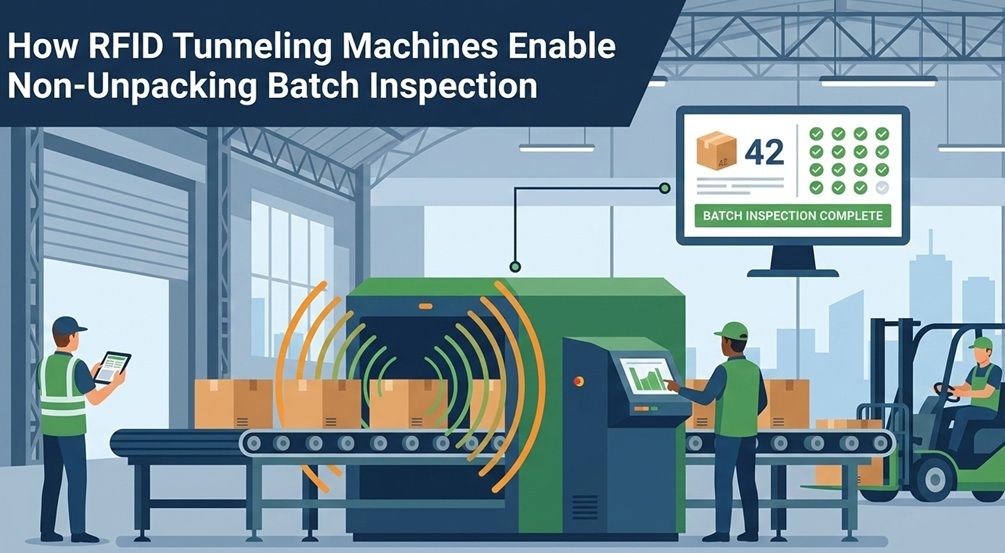
An RFID tunneling machine is essentially an automated reading channel integrating multiple antenna arrays and radio frequency shielding. When cartons loaded with goods tagged with UHF RFID pass through the tunnel via a conveyor belt, multiple sets of circularly polarized antennas inside emit radio frequency signals from different angles, activating all tags inside the carton. Radio frequency absorbing materials on both sides of the tunnel effectively prevent signal leakage and external electromagnetic interference. Combined with a high-sensitivity reader, the system can complete batch reading of hundreds of tags within 0.5 seconds and filter redundant data through RFID middleware to generate accurate shipping/receiving lists.
Core Hardware and Standard Selection Guidelines
To achieve reliable, non-open-box inspection, the hardware must adhere to strict protocol standards and use industrial-grade models:
- リーダー: A high-performance four-port reader supporting EPC Gen2v2 and ISO 18000-6C is recommended, capable of capturing weak backscattered signals.
- アンテナ: A near-field/far-field combined design is required. The near-field antenna can read tags close to the carton wall, while the far-field antenna penetrates the center of the carton.
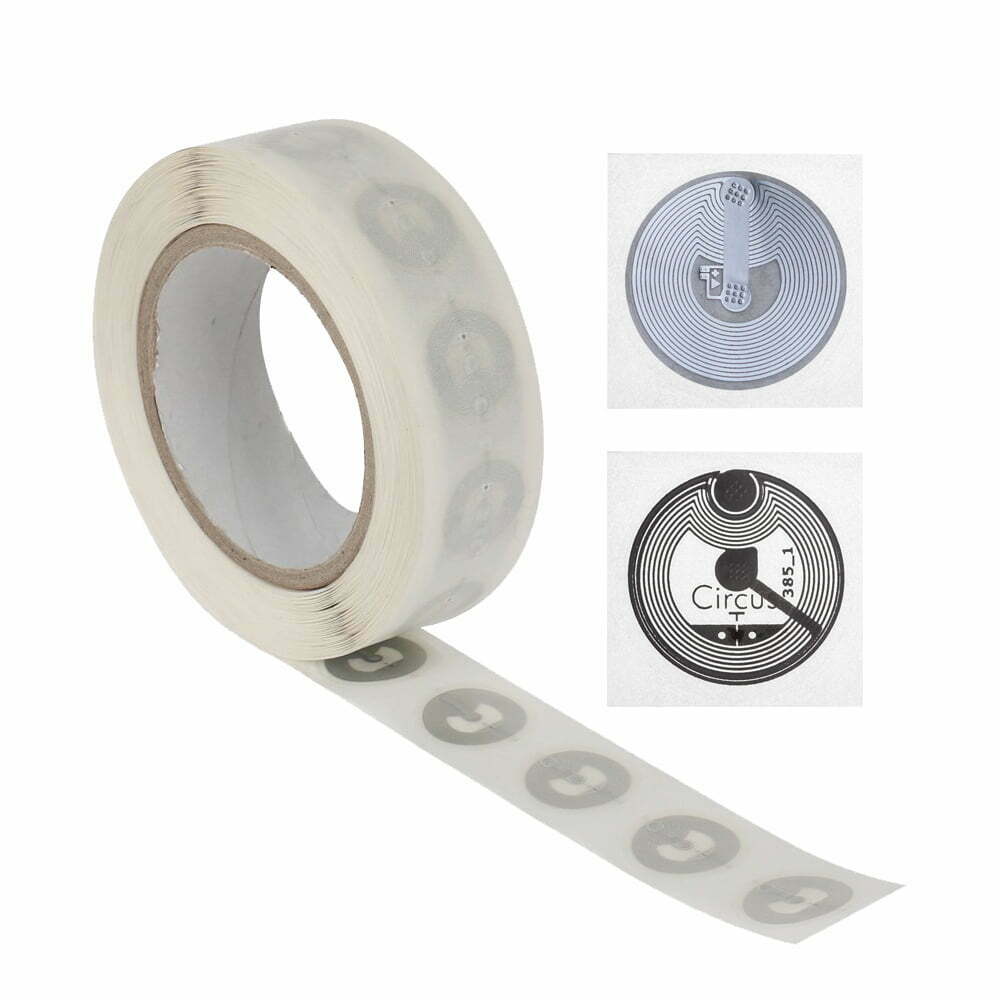
- タグ: Chips that maintain stable performance even in densely stacked environments must be selected, such as NXP UCODE 8 or Impinj M730. Tags must comply with RAIN RFID certification to ensure global frequency band compatibility.
- Conveying and Control System: Integrated photoelectric sensors trigger readings and are linked with PLCs to achieve automated sorting.
Implementation Cases and Data Validation
Inditex (Zara’s parent company), a globally renowned apparel retailer, has deployed over 200 RFID tunneling machines in its distribution centers, enabling non-open-box inspection from factory to store. According to its 2023 financial report, this reduced receiving time from an average of 40 minutes per truck to 5 分, and decreased inventory discrepancy by 92%. Another test conducted by the Auburn University RFID Lab showed that on conveyor belts traveling at speeds up to 2 メートル/秒, an optimized tunneling machine configuration can achieve a read rate of 99.97% and a false read rate of less than 0.03%.
Customized Solutions
Adapting to Diverse Packaging Needs: Different industries have vastly different carton sizes, stacking densities, and product materials. 例えば, metal pendants inside clothing boxes may cause radio frequency shadows, while liquid products (such as cosmetics) can absorb signals. したがって, customized tunneling machine design is crucial. 主要な RFIDソリューション などのプロバイダー RFIDHY design antenna layouts for clients through 3D electromagnetic field simulation and develop specialized irregularly shaped or anti-metal tags to ensure consistent batch inspection accuracy regardless of changes in the contents of the boxes.
結論
Tunneling machine-driven non-opening inspection technology has evolved from an optional innovation to a standard feature for efficient and compliant supply chains. It not only significantly reduces labor costs and accelerates inventory turnover but also provides a reliable data collection foundation for item-level traceability and the implementation of digital product passports. Companies should select partners that meet international standards and have customization capabilities to deploy fully validated tunneling machine systems based on their packaging characteristics and throughput requirements.
よくある質問
1.Can RFID tunneling machines read all types of tags?
Tunneling machines can read passive UHF RFIDタグ compliant with ISO 18000-6C and EPC Gen2 standards. しかし, for certain special tags (such as anti-metal and high-temperature resistant tags), the antenna power and layout need to be adjusted according to their radio frequency characteristics.
2.What is the typical return on investment period for tunnel RFID tags?
According to data from the Materials Handling Research Institute, for distribution centers with a daily processing capacity exceeding 5,000 boxes, the return on investment period for tunnel RFIDタグ is generally within 12-18 数ヶ月. Savings mainly come from reduced manpower, lower losses from incorrect shipments, and optimized inventory holding costs.
3.How to ensure a near 100% 読み取り速度?
The key lies in three points: 1) Using high-sensitivity readers; 2) Carefully designing the antenna layout to cover all angles; 3) Selecting RFID tags with consistent performance and avoiding metal obstructions when attaching the tags. It is recommended to conduct Faraday cage testing to verify the actual read performance before deployment.