Introduction: Data-Driven Selection Decisions
In the digital transformation of the textile industry, the performance of RFID tags directly determines the reliability of data collection. This product evaluation aims to compare five mainstream RFID tags for textiles through standardized testing, providing objective and quantifiable decision-making basis for your chip selection and project deployment.
Different chip solutions and packaging processes significantly affect the reading performance and washability of the tags. There is a performance gap between general-purpose and customized solutions.
Test Environment and Methodology
To ensure the fairness and repeatability of the evaluation, the tests strictly followed industry standards. We built a UHF RFID test environment compliant with the ETSI EN 302 208 standard, using a fixed-power RFIDHY HY-R346A reader and antenna. The performance evaluation covers two core dimensions:
- Initial reading sensitivity and batch reading speed;
- Washability, referring to the AARH testing concept, conducting 30 industrial washing cycles at 85°C (using alkaline detergent), and monitoring performance degradation after each wash. The five selected tags are flexible tags (RFID Inlays) suitable for textiles.
Comparison of Performance Data of Five Tags
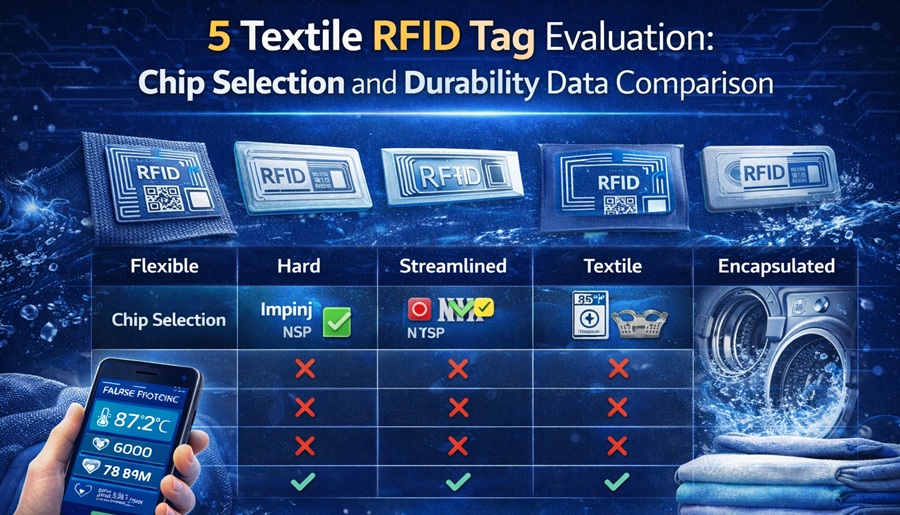
This evaluation focuses on five commercial tags based on different chips, with the following performance:
- Tag A (based on Impinj M730 chip): The longest initial reading distance (up to 8.5 meters), with a success rate of up to 99.7% in batch reading of densely stacked items (200 pieces). However, after 20 washes, its reading distance decreased by about 15%, and slight wrinkling appeared at the edges of the packaging.
- Tag B (based on Alien H9): The largest data capacity (128-bit EPC + 512-bit user memory), with stable initial performance. Its resistance to liquid interference is outstanding, and the performance degradation after washing is minimal (only 8% loss in reading distance after 30 cycles), making it suitable for scenarios requiring the storage of extended information such as washing history.
- Tag C (based on NXP UCODE 9): Performs relatively stably near metal environments, but initial reading sensitivity is average (approximately 6 meters). Washability is moderate, with approximately 20% performance degradation after 25 cycles.
- Tag D (General-purpose passive tag): Lowest cost, with an initial reading distance of approximately 5 meters. However, it has a higher read failure rate in bulk reading scenarios (approximately 5%), and poor washability; some tags fail after 15 cycles, failing to meet industrial-grade long-term use requirements.
- Tag E (RFIDHY Customized Washable Solution): Uses the Impinj M780 chip and proprietary packaging technology. Test data shows that it performs best overall in terms of washability and performance stability: the reading distance retention rate exceeds 95% after 30 washes, and the attachment and reading performance is highly consistent across different fabrics (cotton, synthetic fibers, blends), demonstrating the deep optimization capabilities of customized solutions for complex application scenarios.
Evaluation Summary and Selection Recommendations
This product evaluation clearly shows that chip selection is fundamental, but the packaging process tailored to specific applications (such as long-term washing, special fabrics) is crucial in determining tag lifespan.
- For high-value clothing, workwear requiring long-term traceability, or high-standard Digital Product Passport (DPP) projects, solutions with proven durability, such as Tag B or Tag E, should be prioritized.
- For fast fashion items with extremely sensitive costs and short lifecycles, Tag D can be an entry-level option, but with a higher risk of data loss.
Collaborating with suppliers like RFIDHY, who can provide customized testing and solutions, is an effective way to ensure project success and avoid the risk of large-scale tag replacement later on.
Q&A
1. How was the “bulk reading” success rate tested in the evaluation?
We attached each type of tag to 200 standard cotton T-shirts, densely stacked them in a metal cage cart, and used a fixed reader at a portal channel with standard power for full-volume reading. The test was repeated 100 times to calculate the average reading success rate, simulating a real-world industrial scenario such as warehouse sorting or store inventory.
2. Why do customized tags (such as Tag E) perform more stably in the tests?
The core advantage of customized tags lies in “system-level optimization.” Suppliers (such as RFIDHY) not only select high-performance chips but also specifically adjust the antenna design, packaging materials (such as special PET and adhesives), and bonding process based on fabric characteristics, washing chemicals, and friction methods. This complete control from chip to packaging ensures a perfect match between the tag and the final usage environment, something that general-purpose tags cannot achieve.
3. What are the minimum configuration recommendations for companies that want to build their own testing environment?
It is recommended to equip at least one standard UHF reader/writer supporting the EPC Gen2v2 protocol (such as the RFIDHY HY-R346A), a linearly polarized antenna, an RF power meter, and a small laboratory washing machine with controllable temperature and rotation speed. During testing, key RF performance indicators such as RSSI (signal strength) and read rate should be recorded.
For more information,please contact us.