Introduction: Choosing the Right Hardware is the Cornerstone of Textile Industry Digitalization
By 2026, over 25% of industrial-grade apparel globally will utilize RFID for full lifecycle management. For textile brands, building a stable and scalable digital system hinges on the underlying RFID hardware. Washable tags, capable of withstanding rigorous washing procedures, have become a core component for implementing Digital Product Passports (DPP) and sustainable asset management for textiles. This guide aims to provide a professional framework focused on industrial-grade hardware selection.
Level One: Chip and Air Interface Protocol Selection
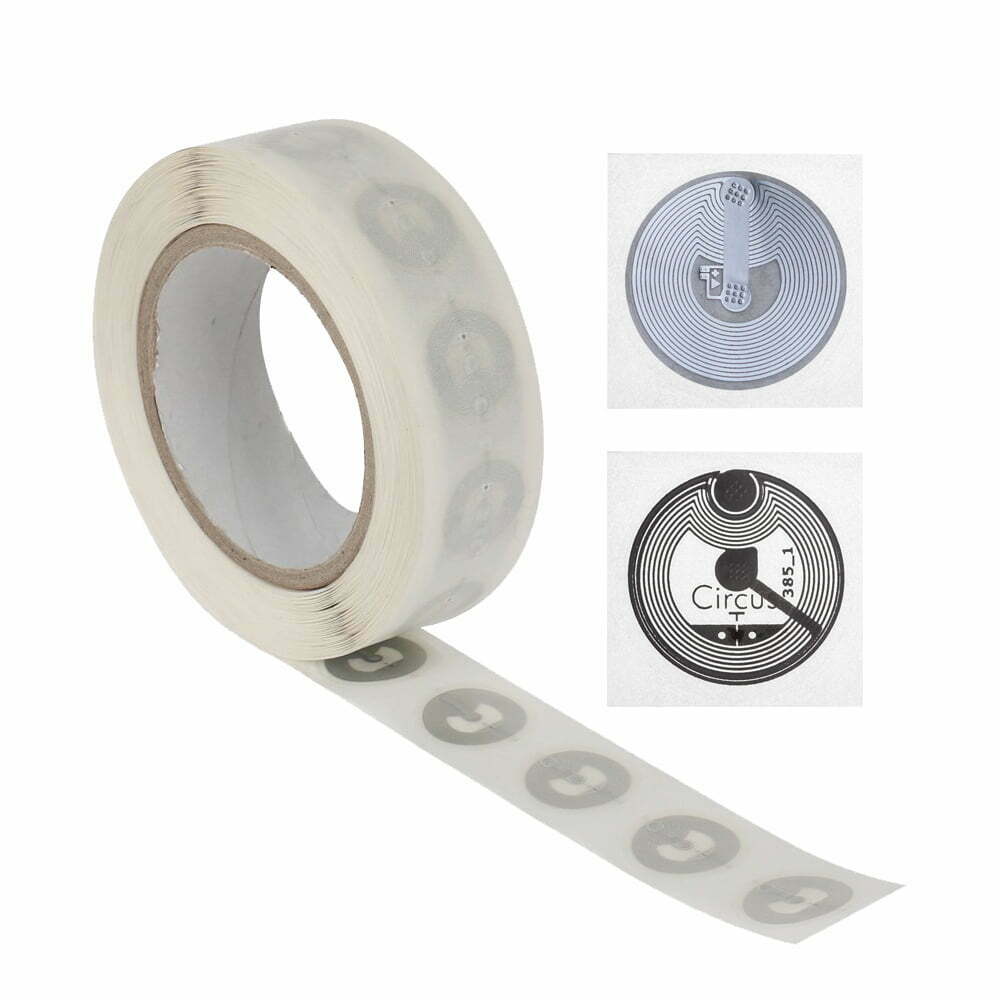
The starting point for selection is the chip, which determines the tag’s performance characteristics. It is essential to select chips that fully comply with the ISO/IEC 18000-6C (RAIN RFID) international standard to ensure compatibility with global supply chain readers and writers. For washable tag applications, priority should be given to models with excellent RF stability and sensitivity.
For example, Impinj Monza® R6 and M780 series chips perform stably in complex media (such as damp fabrics); while Alien Higgs® 9 chips are known for their high storage capacity and interference resistance, suitable for storing extended data such as washing history. These chips are the technical foundation for reliable batch reading and long-term data carriers.
Level Two: Tag Packaging and Industrial-Grade Durability Standards
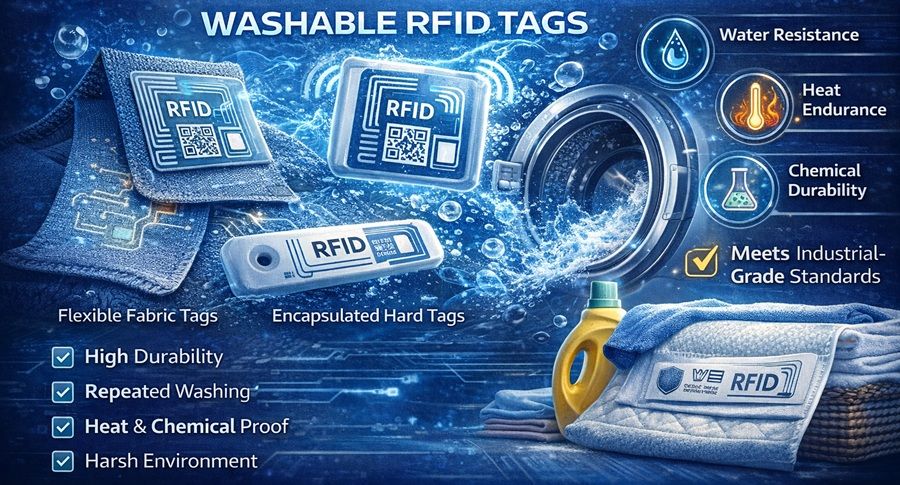
The chip needs to be packaged into industrial-grade hardware capable of withstanding harsh physical and chemical environments. A qualified washable tag for textiles must pass a series of standardized tests, not merely claim to be “washable.” Key standards include:
- High Temperature and Chemical Resistance: Must adhere to the climate and chemical environment requirements specified in standards such as IEC 60721-3-3. The labels should be able to withstand the high temperatures of 60°C-85°C, alkaline detergents, and subsequent drying and ironing processes commonly used in industrial laundering.
- Mechanical durability: Must pass AARH (American Association for Railroads) rating tests, for example, achieving Level 10, meaning the label can withstand over 100 industrial washing cycles at 85°C while remaining fully functional.
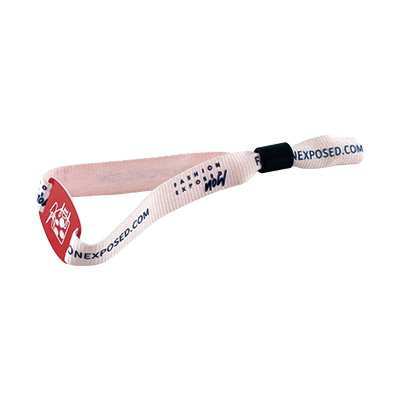
- Packaging forms: Common industrial-grade packaging includes sew-in labels (directly sewn into garment seams or care labels), heat-transfer wristband labels (used for workwear management), and special wash-resistant labels.
Professional suppliers like RFIDHY specialize in providing customized packaging solutions based on the customer’s specific fabric composition, washing process, and data capacity requirements, ensuring the labels remain unobtrusive, undamaged, and reliable throughout their lifecycle.
Third Level: Read/Write Equipment and System Integration Considerations
The selection of industrial-grade hardware hinges on the read/write equipment.
- Fixed readers (such as HY-R346A) are suitable for factory production lines, sorting centers, and warehouse portals, enabling efficient batch identification.
- Handheld terminals (such as RFIDHY HY-R6100) are suitable for store inventory and inspections.
During selection, it is crucial to ensure that the reader’s radio frequency performance matches that of the selected labels and to conduct rigorous on-site environment testing before deployment to optimize reading distance and accuracy, addressing complex scenarios such as textile stacking and metal shelving.
Conclusion
Selecting RFID hardware for the textile industry in 2026 is a strategic decision concerning data continuity and return on investment. The key to success lies in:
- Choosing chips that comply with global protocol standards;
- Adopting label packaging that has passed authoritative industrial-grade durability certifications (especially wash-resistance certification);
- And equipping it with matching read/write equipment.
Collaborating with partners possessing deep industry knowledge and customized development capabilities (such as RFIDHY) is the optimal path to mitigate risks and achieve project success.
Q&A
- How can I easily and quickly verify if an RFID label is truly “wash-resistant”?
First, request a third-party authoritative test report from the supplier based on AARH or similar industrial-grade standards. Secondly, you can conduct small-batch “stress tests” yourself, simulating or even exceeding the strictest washing, drying, and ironing parameters of your actual production line, and then check the physical integrity and data readability of the labels.
- How to select RFID tags for special industrial uniforms that require contact with bleach or strong acids and bases?
This is an extreme application scenario, and standard washable tags may not be sufficient. In this case, in-depth customized communication with the supplier (such as RFIDHY) is necessary. Special chemically inert packaging materials (such as specific engineering plastics or coatings) should be selected, and the chip selection should favor models with stronger anti-interference capabilities, followed by targeted research and testing.
- How long do RFID tags typically last? Do I need to consider the number of data read/write cycles?
High-quality industrial-grade RFID tags have a physical lifespan of over 10 years or hundreds of washes. From a data storage perspective, their EEPROM memory typically supports approximately 100,000 erase/write cycles, far exceeding general application requirements. Therefore, for textile DPP applications, the lifespan bottleneck is usually in the physical packaging rather than the chip itself.
For more information,please contact us.