Introduction: The Standardization Pillar of Textile DPP
The successful implementation of the EU Digital Product Passport (DPP) for textiles hinges on interoperable global standards. At the heart of the DPP is the use of RFID as a key data carrier, governed by a series of protocol standards to ensure seamless data collection, sharing, and querying across borders. This article outlines the key global standards, focusing on the crucial role of EPCIS 2.0 (Electronic Product Code Information Services) and the ISO 18000-6C air interface protocol in building a transparent and compliant textile ecosystem.
The Foundation: RFID Air Interface and Encoding Protocol Standards
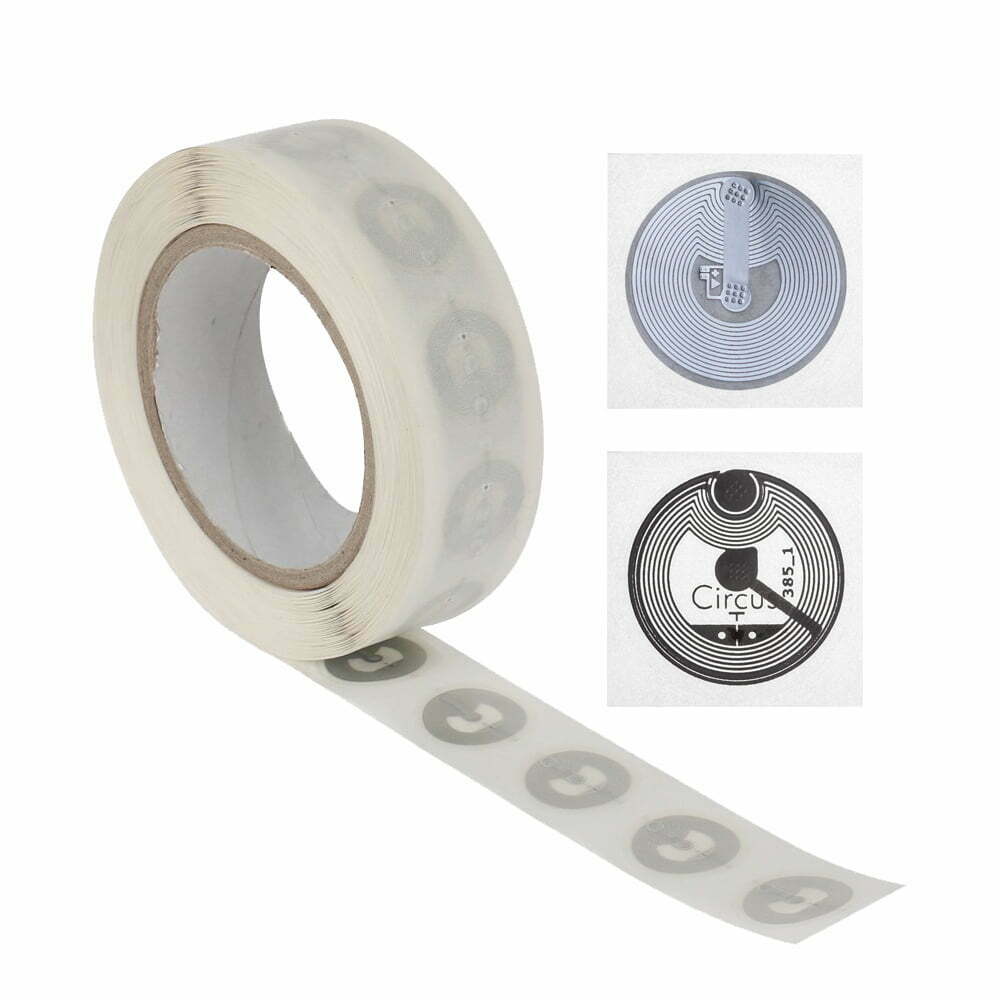
Effective item-level tracking begins with consistent identification. The UHF RFID field primarily utilizes the ISO/IEC 18000-6C standard, which is compatible with the GS1 UHF Gen2v2 protocol. This protocol standard defines how RFID readers communicate with tags, ensuring reliable bulk reading of garment items globally. It standardizes key operating parameters such as frequency (860-960 MHz) and TID (Tag Identifier). Standard-compliant chips (e.g., from Impinj or NXP), along with suitable RFID tags and washable RFID tags for textiles, form the physical layer of the DPP. Specialized suppliers like RFIDHY provide customized RFID inlays that meet these stringent protocol standards and offer durability throughout the garment’s lifecycle.
The Connecting Framework: EPCIS 2.0 as the DPP Event Hub
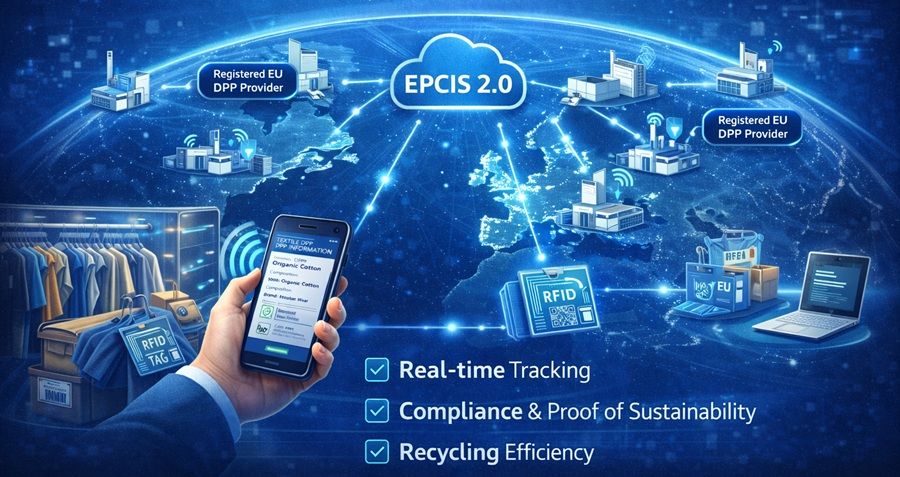
While RFID tags record “what” and “where” a product is, EPCIS 2.0 defines “when,” “why,” and “how” events occur in the product’s journey. This open GS1 standard provides a standardized format for recording and sharing supply chain events – what happened to an item, where, when, and why. For textile Digital Product Passports (DPPs), each key event (manufacturing, transportation, washing, recycling) can be recorded as an EPCIS event. The 2.0 version update enhances support for circular economy data, such as material composition and recycling instructions, which directly aligns with DPP requirements. This transforms fragmented data into a coherent, queryable chain of custody.
Practical Application: From Label to Passport
In a typical DPP workflow, garments tagged with UHF RFID labels compliant with ISO 18000-6C are uniquely identified at each supply chain node. Each read event (e.g., leaving the factory, arriving at the distribution center) is formatted as an EPCIS 2.0 event and sent to a secure, interoperable repository. When a consumer or regulator scans the product’s QR code or RFID tag, the system queries through the EPCIS 2.0 interface, aggregating all relevant events and static data to present a complete digital passport. This object event and aggregation event model ensures auditable traceability.
Conclusion and Strategic Outlook
For brands preparing for textile DPPs, adopting the three global standards—ISO 18000-6C (physical reading), GS1 EPC encoding (identification), and EPCIS 2.0 (data sharing)—is essential. This framework guarantees system interoperability, reduces vendor lock-in, and ensures compliance with evolving regulations. Proactive companies are already partnering with specialized RFID solution providers to design and implement standards-compliant and future-proof tagging and data strategies.
Q&A
1.What are the main differences between EPCIS 1.2 and EPCIS 2.0 in terms of DPPs?
EPCIS 2.0 introduces explicit data fields for circular economy needs, such as product sustainability attributes and durability information, which are crucial for the EU DPP. It provides a more flexible and comprehensive data model than its predecessor.
2.Is ISO 18000-6C the only RFID standard for textiles?
While ISO 18000-6C (Gen2v2) is the primary global protocol standard used for UHF supply chain tracking, other standards, such as ISO/IEC 29143 (for item management), may also be relevant. However, due to its performance and cost-effectiveness, Gen2v2 has become the de facto preferred solution for garment item-level tagging.
3.How can brands practically implement a system compliant with EPCIS 2.0 standards?
The implementation process involves deploying compliant RFID hardware, integrating event capture software at key points, and establishing an EPCIS 2.0 repository. Many brands partner with solution architects like RFIDHY, who provide end-to-end customized RFID solutions—from RFID tag encoding to system integration—ensuring compliance with all necessary protocol standards.
For more information,please contact us.