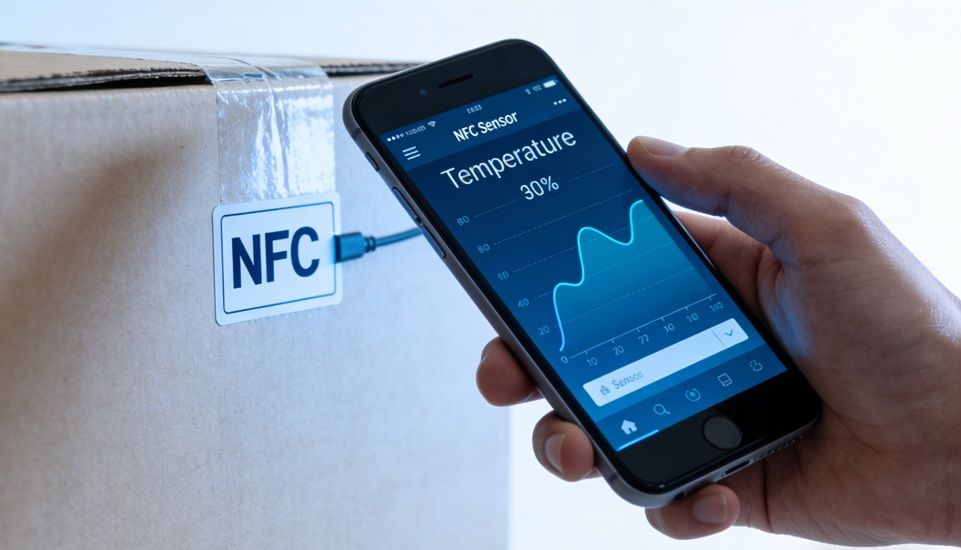
Active Logging vs. Passive Real-time NFC Sensors
| Dimension | Active Logging (Battery-powered) | Passive Real-time (Battery-less) |
| Power Source | Built-in thin-film lithium battery or button cell. | Powered entirely by the magnetic field induced by a nearby mobile phone’s NFC reader. |
| Monitoring Mechanism | Autonomous Monitoring: Can be configured to automatically record data at set intervals (e.g., every 5 minutes). | Triggered Monitoring: Data is captured only at the precise moment a mobile phone is brought into proximity to “scan” the sensor. |
| Data Depth | Provides a complete historical profile (e.g., temperature fluctuations over the past 7 days). | Provides only the current, single-point value. |
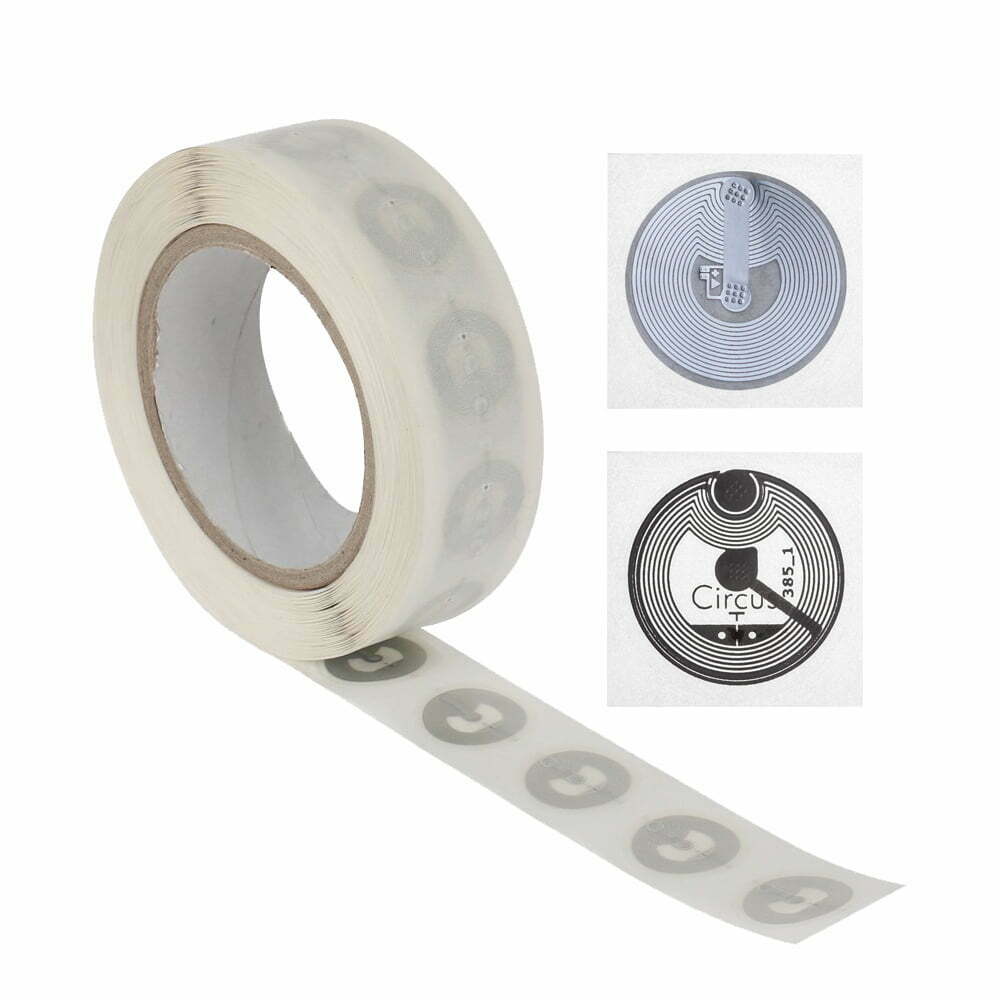
| Product Thickness | Slightly thicker (approx. 0.5mm – 1.2mm) due to the inclusion of battery components. | Ultra-thin, sticker-like form factor (< 0.3mm); visually indistinguishable from a standard label. |
| Storage Capacity | Large memory capacity (capable of storing thousands of historical data logs). | Minimal memory (typically stores only the current status and UID). |
| Environmental Impact | Requires consideration for battery recycling and air transport restrictions (UN38.3). | Eco-friendly: Contains no heavy metals and is exempt from air transport restrictions. |
| Cost (Unit Price) | High ($5 – $15) | Low ($1 – $3) |
Core Scenario Decision Guide
1.When to choose “Active Logging” sensors?
- Comprehensive Quality Traceability: For instance, during the cross-border shipment of high-end biopharmaceuticals. If the cargo experiences temperature excursions while in transit (when no mobile device is scanning), the battery-powered chip will record these events.
- High-Value Assets: Artworks or precision instruments of extremely high value that require 24/7 environmental monitoring—such as for vibration or humidity fluctuations.
- Regulatory Compliance: The healthcare industry often mandates “continuous monitoring reports” rather than mere single-point readings.
2.When to choose “Passive Real-time” sensors?
- Consumer Anti-Counterfeiting & Interaction: For products such as fine wines or cosmetics. Consumers typically only want to verify whether “the specific bottle currently in their hands” is authentic and what its immediate condition is.
- Mass-Market Consumer Goods (FMCG): Scenarios where cost sensitivity is extremely high, and packaging must remain as thin as possible to facilitate automated labeling processes.
- End-Point Verification: Used solely for rapid quality checks at the moment of receipt (serving as a point-to-point verification tool).
For more information,please contact us.