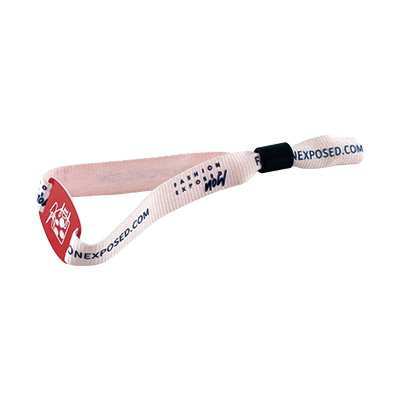
In industrial standards, IP68 represents the highest level of dust and water protection. For wristbands containing embedded precision NFC chips and antennas, rigorous testing is a prerequisite for ensuring stable read/write performance in wet, high-pressure environments.
1.What is IP68?
IP (Ingress Protection): The degree of protection against the intrusion of solids and liquids.
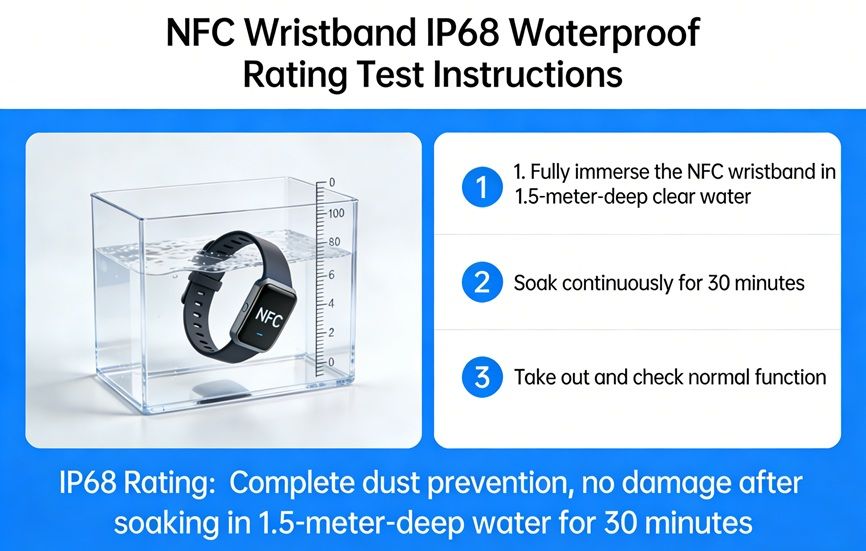
- “6” (Dust Protection Rating): Complete protection against dust ingress. Tested in a vacuum environment for 8 hours, resulting in absolutely no internal dust accumulation.
- “8” (Water Protection Rating): Capable of continuous immersion in water under conditions specified by the manufacturer without sustaining damage. The standard typically requires: immersion at a depth of 1.5 meters for a duration of 30 minutes or longer.
2.Key Testing Protocol
Before leaving the factory, our NFC wristbands undergo the following four-dimensional waterproof and pressure tests:
Static Immersion Test:
- The wristband is submerged in 1.5 meters of clear water for 60 minutes. Afterward, it is removed for NFC read/write performance testing; the sensing distance attenuation must be less than 5%.
Pressure Cycling Test:
- Simulates the hydrodynamic pressure generated by swimming strokes or the high-speed impact experienced on water slides. The wristband is placed in a pressurized vessel to simulate instantaneous pressure levels of 3 to 5 atmospheres (3-5 ATM).
Warm Water/Saltwater Tolerance:
- Tailored for scenarios involving hot springs and beaches, the wristband is immersed in 40°C warm water and a 3.5% saline solution. This test verifies whether the encapsulation material (silicone/ultrasonically welded joints) exhibits swelling or corrosion.
Thermal Shock Test:
- Simulates the temperature differential experienced when moving from a freezing pool into a sauna. The wristband is subjected to rapid temperature cycling between -20°C and +60°C to check for internal antenna fractures caused by thermal expansion and contraction.
3.Core Encapsulation Technology: How is IP68 Achieved?
- Integral Molding Process: Silicone wristbands typically utilize a process where the chip is completely encapsulated via injection molding. The chip is completely encapsulated within a layer of medical-grade silicone exceeding 1 mm in thickness, leaving absolutely no gaps.
- Ultrasonic Welding: Applied to rigid plastic clasps, this technique utilizes high-frequency vibrations to fuse the upper and lower housing components. This molecular-level bond is more reliable than any adhesive.
- Epoxy Filling: In certain customized wristbands, internal voids are filled with high-polymer epoxy resin, thereby completely eliminating any potential pathways for moisture ingress.
For more information,please contact us.