To ensure the accuracy and repeatability of the aforementioned empirical data, our engineering team conducted multiple rounds of testing within a controlled laboratory environment. The following outlines the standard configuration used for this testing:
1.Test Equipment (Hardware Setup)
- Reference Readers: Mainstream smartphones (iPhone 15 Pro and Samsung Galaxy S23) were utilized as the mobile-side benchmarks; for the industrial-side benchmark, an ACR122U USB reader was used (output power standard: 50mm effective field strength).
- Measurement Tools: High-precision, non-metallic calipers (to avoid electromagnetic interference), with an accuracy of ±0.1mm.
2.Environmental Parameters (Environmental Constraints)
- Media Interference: Testing was conducted on a non-metallic, wooden tabletop to ensure that no large metal objects or radio emission sources were present within a 50cm radius.
- Temperature and Humidity: Standard laboratory conditions were maintained (Temperature: 25°C; Humidity: 45%–55%) to eliminate the potential impact of extreme environmental conditions on the efficiency of the chip’s charge pump.
- Sensing Angle: The plane of the tag was positioned parallel (180°) to the plane of the reader’s antenna. This represents the ideal angle for achieving the maximum sensing distance.
3.Test Protocols and Samples (Protocol & Samples)
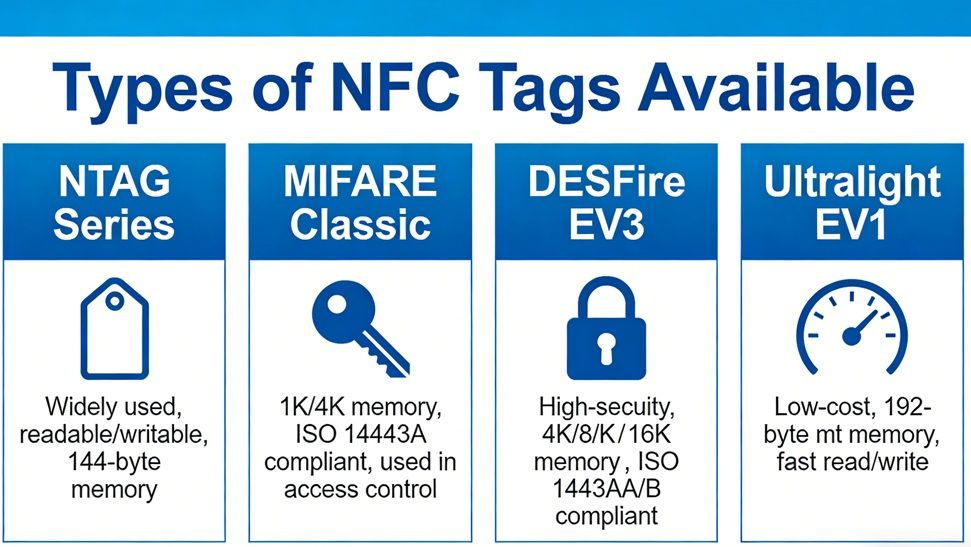
- Chip Standards: All samples utilized genuine NXP NTAG21x series and ICODE SLIX chips.
- Data Payload: All test tags were pre-written with a standard NDEF URL record (approximately 30 bytes) to simulate the most common marketing redirection scenarios.
- Sampling Method: Ten samples of each model type were selected for testing, and the final reported data represents the arithmetic mean of these results.
💡 Professional Advice for Clients (Engineer’s Note)
For actual deployments, we recommend that clients adhere to the “70% Rule”: when planning a system, treat 70% of the empirically measured maximum distance as the reliable interaction distance. For example, if the measured maximum distance is 4cm, we recommend guiding users—via the UI interface or posted instructions—to position the tag within a range of 2.5cm to 3cm to ensure a 100% first-time recognition success rate.
For more information,please contact us.