asetuksessa, sustainability pressure and digital-twin expectations are rapidly converging in the European tyre industry. End-of-life tyres represent one of the most visible waste streams in Europe: they are highly recyclable, yet difficult to manage once they enter dispersed aftermarket channels. Tyres are therefore becoming one of the first product categories to receive a dedicated digitaalinen tuotepassi under the EU Ecodesign for Sustainable Products Regulation and the upcoming EU Tyre Regulation.
This article explains what the tyre digitaalinen tuotepassi means for manufacturers, retreaders and recyclers, ja miksi NFC -tunnisteet are an important enabler for reading and writing sustainability data throughout the tyre life cycle. If your organisation is starting to evaluate digital product passports, see the Digital Product Passport solutions at NFCWORK for a broader technology overview.
What the EU Tyre Regulation Means for Tyre Manufacturers
The Ecodesign for Sustainable Products Regulation, published as Regulation (EU) 2024/1781, entered into force in July 2024 and establishes the legal foundation for product-specific digital passports. Tyres have been prioritised because they are material-intensive, safety-relevant, and generate an end-of-life stream that is notoriously difficult to trace once a tyre leaves the factory gate.
The future EU Tyre Regulation is being developed as a delegated act under that framework. It is expected to introduce mandatory product requirements related to rolling resistance, wet grip, melua, käyttää, kierrätettyä sisältöä, retreadability and repairability. Within those requirements, a tyre digital product passport will act as the structured data carrier that links each physical tyre to sustainability and compliance information.
For manufacturers and value-chain partners, the strategic message is clear: the next tyre placed on the market may need to be traceable not only as a physical product, but as a data object that records how it was made, used, retreaded and eventually recycled.
EU Tyre Regulation Timeline: Stages Compliance Teams Should Watch
The exact dates are still moving as part of the EU legislative process. The table below outlines the publicly expected regulatory milestones for the tyre digital product passport and the EU Tyre Regulation.
>
| Virstanpylväs | Why it matters for tyre stakeholders | Ohjeellinen ajoitus |
|---|---|---|
| asetuksessa (EU) 2024/1781 entry into force | Creates the horizontal legal framework for digital product passports, data security and interoperability | 2024 |
| ESPR working plan identifies tyres as a priority product group | Triggers the preparation of a tyre-specific delegated act under the EU Ecodesign framework | 2025-2026 |
| Draft delegated act for tyres published for public consultation | Will specify tyre digital product passport data fields, product scope and access requirements | Expected 2025-2026 |
| Adoption of the delegated act and entry into force | Makes the tyre digital product passport a formal compliance requirement for covered tyre categories | Expected 2026-2027 |
| Application after the transition period | Regulators and market surveillance authorities may require proof of compliance before tyres are placed on the EU market | Ohjeellisesti 24 months after adoption |
These dates should be treated as a planning basis rather than as a fixed legal deadline. Organisations that begin piloting data architectures early will be much better positioned than those that wait for the final delegated act.
Tyre DPP Data Fields You Should Already Be Mapping
Although the tyre-specific data schema has not yet been finalised, the EU DPP framework already points to a common set of data fields. The following tyre sustainability data categories are likely to become part of the tyre digital product passport:
- Manufacturer identification, production site, batch and lot numbers
- Unique serial identifier linked to an NFC -tunniste or other data carrier
- Tyre type, koko, load index, speed category and intended service class
- Material composition including rubber, carbon black, silica, teräs, textile and additives
- Recycled content and bio-based content by component or by percentage
- Substances of concern and relevant chemical compliance information
- Tyre label performance values such as rolling resistance, wet grip and rolling noise
- Retreadability status and the maximum number of retread generations permitted
- Korjaus, maintenance and service event logs
- End-of-life sorting and recycling instructions for collectors and recyclers
Not every field needs to be physically stored on the tag. For an NFC-based tyre DPP, the tag should contain a unique identifier and a secure link to the full passport record in a cloud platform. This keeps the physical carrier simple and allows the DPP to evolve as the tyre moves through its life.
Why NFC Tags In the Tyre Sidewall Are a Practical DPP Carrier
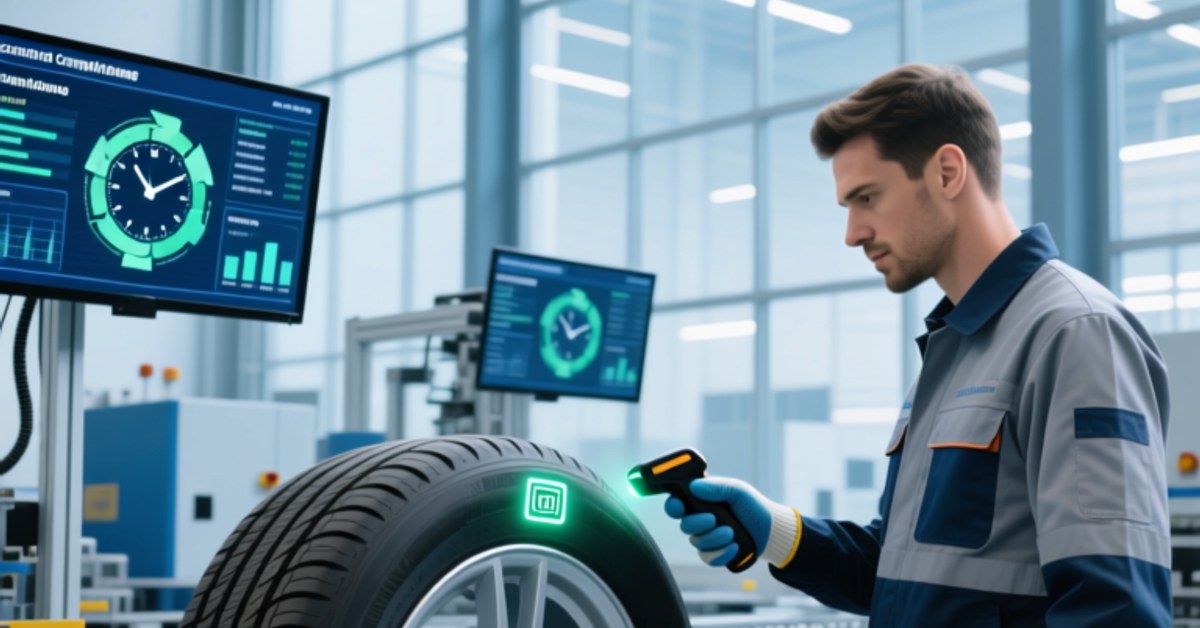
The tyre sidewall is one of the most demanding product environments for any digital marker. It must remain readable in rain, lumi, dirt and heat, and it must survive high-speed rotation, flexing and occasional impacts. QR codes are inexpensive, but they require line-of-sight scanning and can become unreadable when grime builds up on the rubber surface. NFC tags offer a more useful form of access for a tyre digital product passport because they can be read at close range with an NFC-enabled smartphone or a compact NFC reader, even when the surface is not perfectly clean.
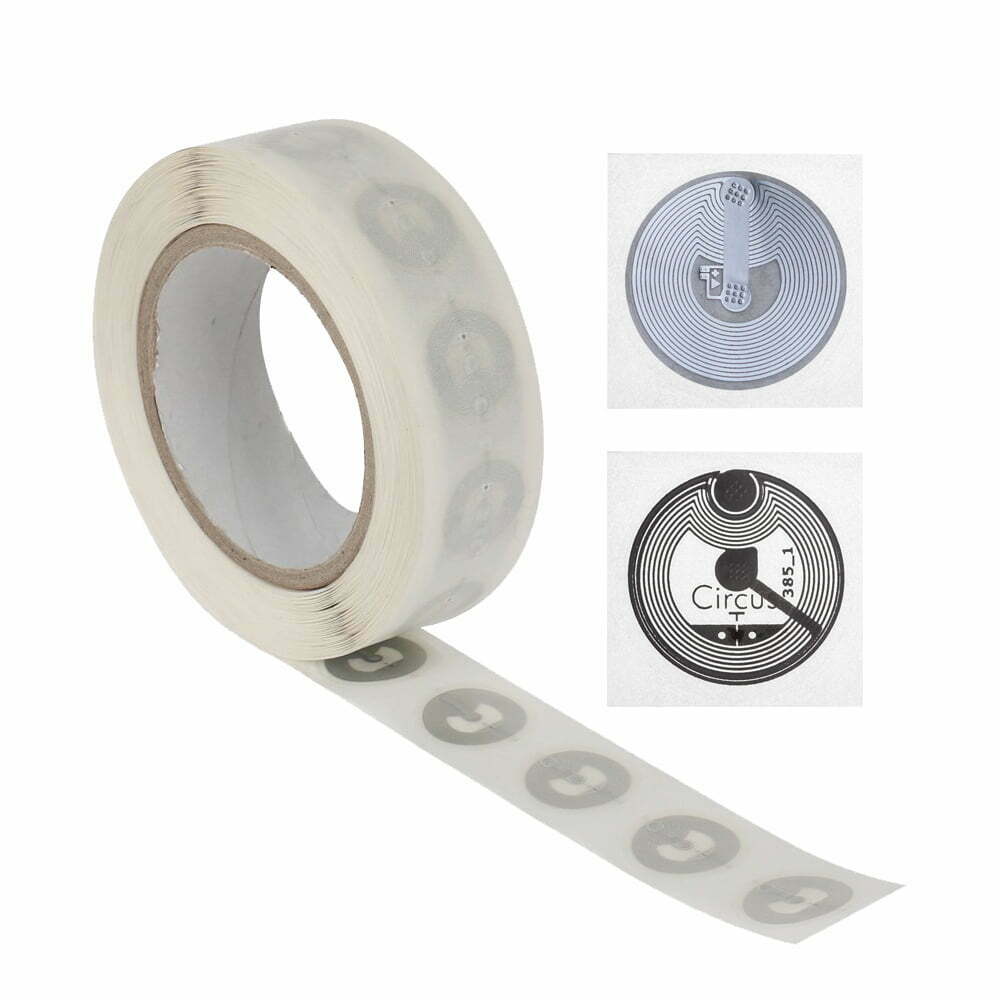
A passive NFC tag contains a small chip and antenna. It needs no battery, no network subscription and no special user account. When a service technician, retreader, customs officer or recycling operator taps the tyre sidewall area with a smartphone, the NFC tag can open the associated tyre DPP record in seconds. This is a major advantage for B2B workflows in which tyres are inspected outdoors and data needs to be captured quickly.
Where does the NFC tag go physically?
For tyre manufacturers, an NFC inlay is usually considered during the tyre design phase rather than applied after production. The tag position should avoid the main flexing zones and maintain the tyre dynamic balance. In many configurations, the NFC tag is integrated into the sidewall or inner liner area during tyre building or curing. Because it is embedded in the rubber structure, it is difficult to remove without causing visible tyre damage, which also gives the tyre DPP a degree of tamper evidence.
NFC inlays and NFC tags used for tyre DPP trials should be tested through vulcanisation, varastointi, service conditions and retreading processes. The final choice of tag material, read range and packaging depends on the tyre type, target temperature profile and expected usage period.
NFC and the link between physical tyre and digital records
Once an NFC tag is embedded in a tyre sidewall, it becomes the digital key to the tyre complete life story. The manufacturer can program the tag with a unique serial number and a DPP URL. Every time the tyre is scanned, the digital system can verify who is accessing the record, what role they have and whether they are allowed to update the data.
For tyre circular economy programs, this means the same physical tag can be used throughout a casing life, including multiple retreading cycles. It also gives tyre manufacturers a direct way to instruct dismantlers and recyclers about the materials inside the tyre and the preferred recovery route.
End-of-Life Tyre Tracking and Circularity: A Field-Level View
End-of-life tyre tracking is not just about knowing where clappers go. It is about proving that material recovery, retreading and recycling actually happen. A tyre digital product passport can close the loop between the producer who puts a tyre on the market and the recycler who turns it into granulate, teräs, textile or pyrolysis feedstock.
The table below illustrates how an NFC-enabled tyre DPP can support the entire circular value chain.
>
| Life-cycle stage | NFC touchpoint | Sustainability and circularity data event |
|---|---|---|
| Tyre manufacturing | NFC inlay embedded into the tyre sidewall area during production | Creation of tyre DPP with batch ID, material composition and performance label data |
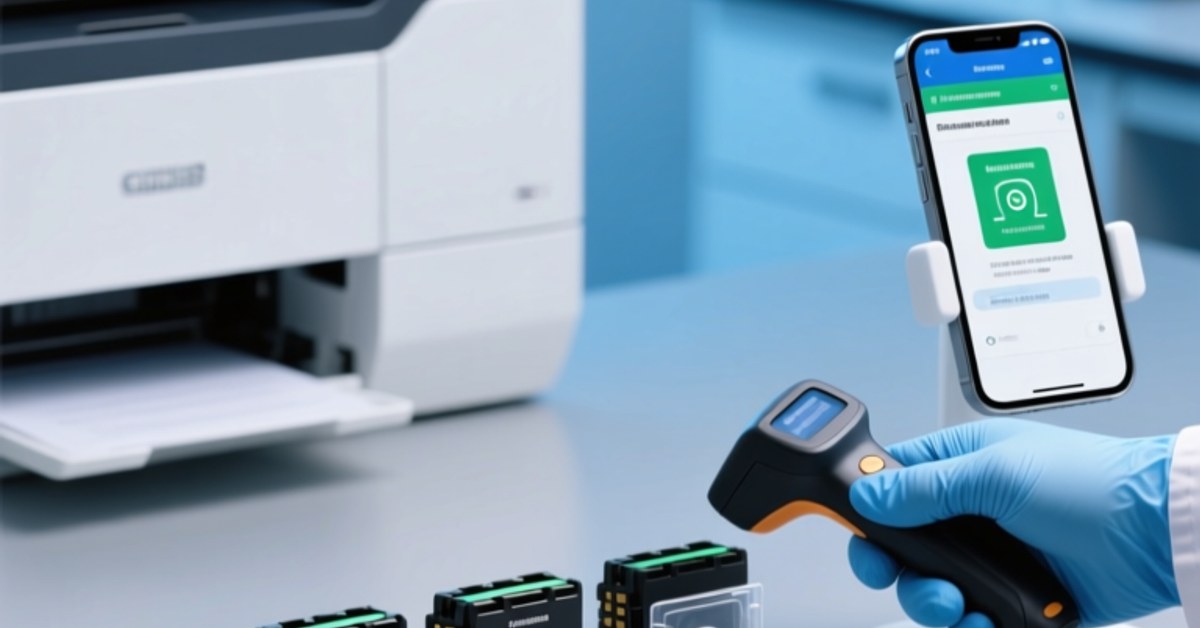
| Distribution and retail | Warehouse operator reads the tag using a handheld NFC/RFID-lukija or smartphone | Stock movement, logistics chain verification and order traceability |
| Use and maintenance | Service centre scans the sidewall before wheel changes or tread depth inspection | Usage mileage, damage records, repair recommendations and retread eligibility |
| Retreading | Retreader scans the casing to check original specification and previous service events | Retread approval, new tread batch date and retread generation number |
| End-of-life collection | ELT collector scans the tyre before it enters the recovery stream | Confirmation that the casing has reached end-of-life and transport details |
| Recycling and recovery | Recycler uses the DPP to identify constituent materials and recycling instructions | Material output quantities, recycling batch reports and feedback into future eco-design |
Retreading and recycling data must be bidirectional
Retreading and recycling data are especially important for the EU tyre regulation because they demonstrate that tyres are designed for circularity. A retreader needs to know, esimerkiksi, whether a casing was previously retreaded, kuinka monta kertaa, and which materials were used for the previous tread. Ilman sitä historiaa, retreaders often need to perform costly and time-consuming inspections.
With NFC-enabled DPPs, a retreader can read the sidewall tag and immediately see the tyre construction type, casing generation and maintenance history. Once the casing is retreaded, the retreader can write new information into the DPP backend, adding a second life record that future readers will see.
Recyclers face a similar data need. End-of-life tyres are complex composites containing different rubbers, steel beads, bead wires and textile cords. The tyre digital product passport can provide recyclers with dismantling guidance and material identification so that every tyre is sent to the most valuable recovery process. This improves the quality of recycled material and contributes to the sustainability data used by future tyre producers.
Supply Chain Implementation: Moving From Regulation to Tyre DPP Reality
Implementing tyre digital product passports is a supply-chain project, not a one-person software task. The manufacturing line must be able to embed the tag, write the unique identifier and connect it to the ERP or manufacturing execution system. Inbound logistics teams need reader infrastructure that is fast enough for high-volume warehouses. Service workshops need simple smartphone-accessible views. Retreaders and recyclers need permission to read and update specific data fields.
The main implementation layers
- Physical layer: Selection of NFC tags, NFC inlays and optional companion RFID labels for sidewall or inner-liner integration.
- Identification layer: Unique serial numbers standardised across production sites and aligned with tyre DPP data models.
- Connectivity layer: NFC-yhteensopiva älypuhelimet, kädessä pidettävät RFID-lukijat, fixed RFID readers and secure gateways that share scan events with the DPP platform.
- Data platform layer: A cloud-based or hybrid DPP repository that manages access roles, versioning and consent controls.
- Interoperability layer: Use of standard identifiers, data exchange formats and API frameworks so actors across different countries and company systems can communicate.
Where to start with your tyre DPP pilot
Compliance teams should not wait for the final delegated act to begin piloting. Start with a single tyre family, a trusted distribution partner and one retread or recycling partner. Test how the NFC tag behaves through curing, varastointi, mounting and multiple scan events. Confirm that the data architecture can connect to your ERP and quality management system. Then expand the pilot to collection channels and recyclers as the EU tyre regulation timeline becomes clearer.
The companies that succeed in this transition will be those that treat the tyre digital product passport as a medium for circularity data, not as a static compliance certificate. NFC tags embedded in the tyre sidewall can connect manufacturers, retreaders, collectors and recyclers in a shared data ecosystem. When every actor can read and contribute to a tyre passport, the circular economy stops being an abstract target and becomes an operational process.
Faq
What is a tyre digital product passport?
A tyre digital product passport is an electronic record linked to a physical tyre or tyre batch. It can contain manufacturer details, materiaalit, kierrätettyä sisältöä, performance values, retreadability information and end-of-life guidance. Under the EU Ecodesign framework and future EU Tyre Regulation, this passport is expected to become mandatory for covered tyre categories and should be accessible through a data carrier such as an NFC tag.
Is NFC durable enough for a tyre sidewall?
NFC tags can be designed into the tyre structure using appropriate packaging and placement. The exact durability depends on tyre construction, vulcanisation temperature, flexing zones and service conditions. Tyre manufacturers should test NFC inlays through the complete production and use cycle before committing to a specific design. Because the DPP data itself is stored in the backend, the NFC tag only needs to survive long enough to provide a reliable identifier link.
When do tyre companies need to start complying with the EU Tyre Regulation?
As of the regulatory milestones announced by the EU, the final tyre-specific delegated act is expected to be published and adopted around 2026-2027. A transition period is likely to follow. Tyre manufacturers, importers, retreaders and recyclers should start digital product passport pilots now so they can refine their data processes before the legal obligation arrives.
What data should go into the tyre DPP first?
Start with stable foundational data: unique tyre identifier, manufacturer and plant, materiaalin koostumus, kierrätettyä sisältöä, tyre type, size and performance label values. Then add retreadability and service log fields that can be updated by downstream actors. The goal is to build a passport that improves its value over the tyre life cycle rather than locking in a fixed certificate at the point of production.
Build Your Tyre DPP Pilot with NFCWORK and RFIDHY
NFCWORK ja RFIDHY provide a range of NFC tags, NFC upotteet, NFC labels and RFID readers that can support tyre digital product passport programs and end-of-life tyre tracking workflows. Whether you need to embed a tag into a tyre sidewall, connect a handheld scanner at a collection point, or design a data carrier strategy for your EU compliance team, our specialists can help you choose the right physical layer for your supply chain.
Talk to our team about prototyping a tyre DPP solution today. Contact us for a technical consultation tai tutkia NFC products for your tyre DPP project.