Core Challenge: Moisture Content is a Critical Variable in Textile RFID Applications
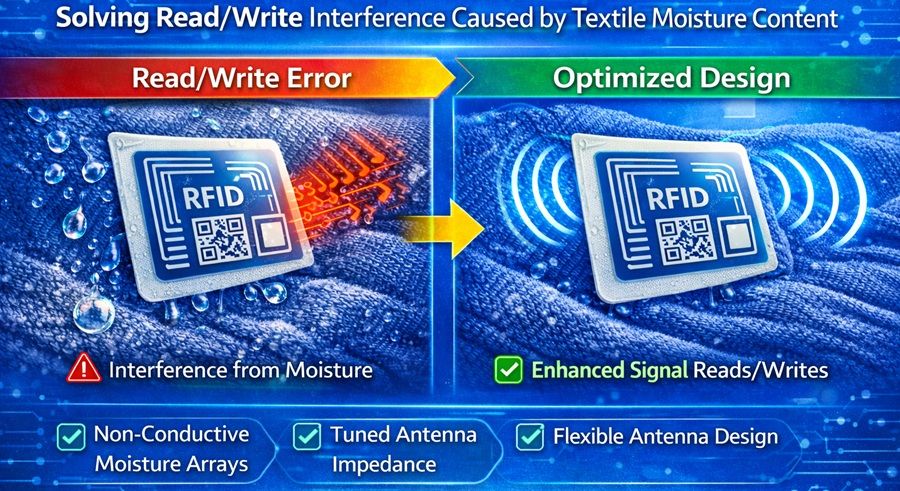
Humidity is an unavoidable environmental factor throughout the entire lifecycle of textiles, from production and warehousing to retail and even digital product passports (DPP). Data shows that when the moisture content of cotton fabric increases from a dry state to 30%, its dielectric constant changes dramatically, leading to a reduction in the reading distance of attached UHF RFID tags by up to 70%. This electromagnetic interference caused by changes in the dielectric medium is the core physical reason for read/write failures in wet environments and data breaks in the supply chain.
Root Cause of the Problem: How Moisture Content Causes Electromagnetic Interference
Water molecules in textiles are polar molecules, which absorb and scatter electromagnetic wave energy in a high-frequency radio frequency field. This directly changes the electromagnetic environment surrounding the tag antenna, mainly in two aspects:
First, the load effect: the moist fabric changes the dielectric constant of the antenna’s near field, causing the antenna’s resonant frequency to drift and become severely detuned;
Second, increased loss: water absorbs radio frequency energy, causing the signal transmitted by the reader to attenuate before reaching the tag, and the signal backscattered by the tag is also significantly weakened.
This complex electromagnetic interference makes the reading rate of general-purpose tags highly unstable in humid conditions.
Systematic Solution: Collaborative Design from Chip to Antenna
Solving this problem cannot rely on a single component, but requires a systematic RFID hardware design.
The primary key is to select a chip with high radio frequency sensitivity and strong anti-interference capabilities, such as the Impinj Monza R6-P or NXP UCODE 9, which can maintain more stable performance in complex dielectric environments.
Secondly, and most decisively, is the customized antenna design. Antenna engineers need to accurately model the moisture content of the target textile (e.g., typical storage humidity of 15%-25%), and compensate for frequency shifts caused by dielectric changes by adjusting antenna trace layout, impedance matching networks, and radiation patterns. For example, this can be achieved by increasing the antenna Q-factor or using a broadband design to tolerate resonance point drift.
Professional Practice: How Customization Ensures Stable Performance
Industry-leading RFID solution providers, such as RFIDHY, overcome this challenge through deep customization capabilities. Their process typically includes:
1) Environmental simulation testing, accurately replicating scenarios with different humidity and fabric combinations in the laboratory;
2) Antenna simulation and optimization, using professional software such as HFSS or CST for iterative design;
3) Producing wash-resistant label prototypes and conducting wet environment read/write verification under AARH standard testing.
Through this “design-simulation-testing” closed loop, the developed textile-specific RFID tags maintain consistent reading performance across a wide range of humidity levels, ensuring the reliability of data carriers from dry warehouses to humid sorting centers.
Conclusion
Overcoming the wet environment read/write challenges caused by textile moisture content is a typical antenna design and environmental adaptability engineering problem. The key to success lies in abandoning generic label solutions and instead adopting a collaborative design and customized development approach based on specific application scenarios (including expected humidity range, fabric type, and washing standards). Partnering with companies possessing RF expertise and industrial-grade testing capabilities is the only way to translate theoretical solutions into stable, high-volume identification capabilities.
Q&A
1.Besides antenna design, what measures can be taken at the reader end to improve wet environment read/write performance?
At the reader end, two main strategies can be employed:
First, use circularly polarized antennas instead of linearly polarized antennas to better cope with random directional changes in the tag due to moisture and wrinkles;
Second, implement power optimization algorithms to dynamically adjust the transmission power based on real-time reading feedback, ensuring readability while penetrating the moisture-containing dielectric layer.
2.How can the wet environment performance of an RFID tag be quantitatively evaluated?
It is recommended to establish standardized performance benchmark testing. The tags are attached to standard fabric samples (such as pure cotton canvas), and the relative humidity is adjusted to different levels (e.g., 30%, 65%, 85%) in a controlled climate chamber. The reading distance, RSSI (signal strength), and batch reading success rate are measured at each humidity level. Compared to the baseline data under dry conditions, the performance degradation rate serves as a key evaluation indicator.
3.What remedial measures are available for companies that have already deployed general-purpose tags but are experiencing problems in humid environments?
Remedial measures can be divided into software and hardware aspects.
In terms of software, the filtering and redundant reading algorithms of the RFID middleware can be optimized to compensate for physical layer instability at the application layer.
In terms of hardware, the most fundamental solution is to replace the tags with customized tags optimized for humid environments in subsequent batches.
Companies can collaborate with suppliers like RFIDHY to conduct rapid problem diagnosis and small-batch customized replacement testing to verify the feasibility of the new solution at minimal cost.
For more information,please contact us.