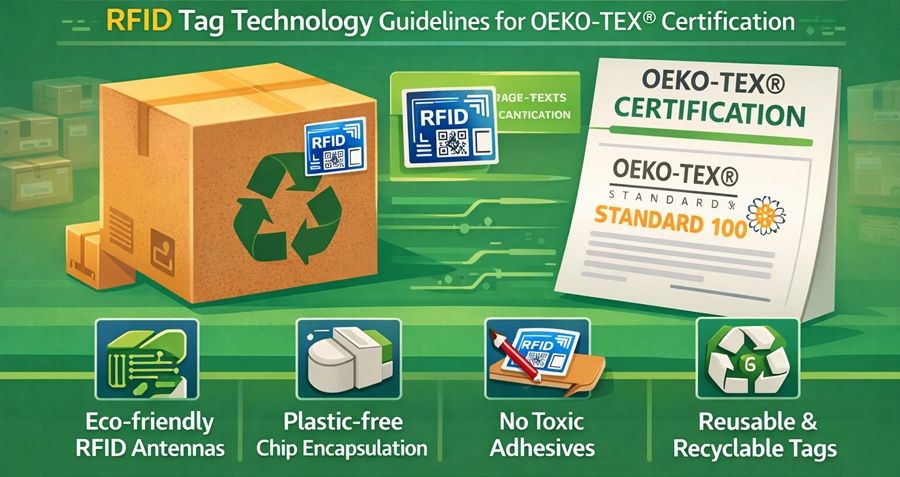
Introduction: Eco-friendly Packaging Becomes the New Standard for Textile RFID
With the implementation of the EU’s Sustainable Product Ecodesign Regulation and brands’ increasing commitment to the circular economy, textile RFID tags themselves must also meet sustainability standards. Data shows that over 70% of globally renowned textile brands have already required their accessory suppliers to provide certifications such as OEKO-TEX for harmful substance testing. Therefore, adopting recyclable and OEKO-TEX compliant eco-friendly packaging is transforming from a “differentiating advantage” to a “necessary ticket” for RFID tags to enter the high-end textile market.
Core Compliance Requirements: Understanding the OEKO-TEX Standard System
OEKO-TEX is not a single standard, but a set of certification systems for different stages of the textile industry. For RFID tags, two main aspects are involved:
- OEKO-TEX STANDARD 100: This is a product-level certification, requiring all components of the tag (chip substrate, antenna ink, packaging film, adhesive) to pass rigorous testing to ensure they do not contain harmful substances (such as heavy metals, carcinogenic aromatic amines, plasticizers), with limits far exceeding ordinary regulations.
- OEKO-TEX ECO PASSPORT: This is a certification for chemicals and auxiliary materials, applicable to the inks, adhesives, and other chemical materials used in tag production. Materials with this certification are the foundation for producing compliant tags.
Using certified eco-friendly packaging materials (such as bio-based or recycled PET film, water-based eco-friendly inks, and halogen-free adhesives) is the only way to meet these requirements.
Technical Implementation: Design and Material Innovation for Recyclable Packaging
Achieving eco-friendly packaging requires a balance between material science and radio frequency performance. Key technical points include:
- Substrate and Film: Using post-consumer recycled PET, biodegradable PLA, or certified paper as the packaging substrate. These materials must have stable dielectric properties to ensure that antenna performance is not compromised.
- Antenna Printing: Using water-based conductive ink (such as those based on nano-silver paste) instead of traditional etching processes, this method is not only more environmentally friendly but also allows printing on a wider range of flexible packaging materials, achieving better flexibility.
- Chip and Connection: Selecting low-power chips that comply with the ISO/IEC 18000-6C standard, such as the Impinj M780 series. Through innovative flip-chip packaging technology, conductive adhesive is used instead of lead-containing solder to interconnect the chip and antenna, further meeting environmental requirements.
Leading RFID solution providers, such as RFIDHY, are leveraging their customization capabilities to develop such tags for their customers. They can select compliant material combinations based on the brand’s specified OEKO-TEX certification level and garment fabric, and optimize antenna design to compensate for any minor adjustments in RF performance caused by environmentally friendly materials, ensuring that read rate and durability are not compromised.
Challenges and Synergistic Value: A Green Closed Loop Throughout the Supply Chain
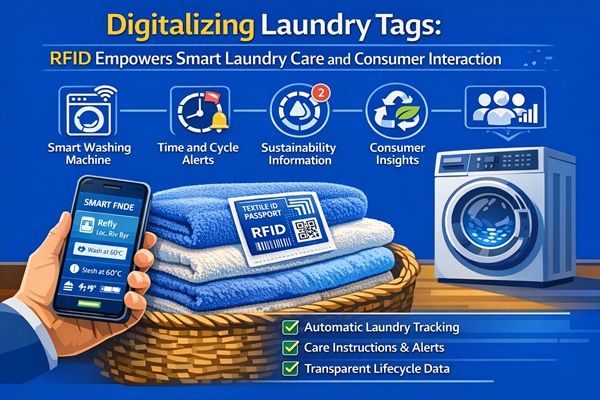
The main challenges lie in balancing cost and performance, and establishing an effective recycling information flow. However, the synergistic value is immense: an OEKO-TEX certified, recyclable RFID tag is not only a safe and harmless data carrier, but its material information can itself be written into a Digital Product Passport (DPP). At the end of the garment’s life cycle, the tag can be efficiently sorted through RFID identification, and its environmentally friendly packaging materials can easily enter the corresponding plastic or paper recycling streams, truly supporting the “cradle-to-cradle” design concept.
Conclusion
Choosing RFID tags with recyclable, environmentally friendly packaging and OEKO-TEX certification for textiles is a forward-thinking strategic decision. It goes beyond tracking functionality itself, deeply integrating digital tools with a brand’s sustainability commitments, and is a crucial step in responding to regulations, enhancing product green competitiveness, and building a responsible supply chain. Collaboration with technology partners possessing relevant materials science knowledge and customized R&D capabilities is essential.
Q&A
1.How to verify the authenticity of the OEKO-TEX certification provided by the RFID tag supplier?
The supplier should provide an official OEKO-TEX® certificate with a unique number. You can visit the OEKO-TEX website’s “Certificate Search” database, enter the certificate number, holder name, and product category to verify online, ensuring the certificate is valid and covers the purchased tag model.
2. Will using environmentally friendly packaging materials (such as PLA or recycled PET) affect the washability of the labels?
This depends on the specific material formulation and packaging process. Unmodified pure PLA may lack sufficient heat resistance and hydrolysis resistance. However, through copolymer modification, the addition of compliant additives, and optimization of the thermal lamination process, it can meet industrial-grade washing standards (such as passing the AARH test). The key lies in the supplier’s material engineering and packaging technology capabilities.
3.For brands with existing RFID projects, how can they transition to environmentally friendly packaging?
A phased approach is recommended. First, communicate with existing suppliers (such as RFIDHY) to develop an upgrade plan and conduct pilot tests with small batches of environmentally friendly packaging labels, performing comprehensive performance and compliance testing. Second, highlight the environmentally friendly attributes of the new labels as a product selling point and update the DPP information. Finally, gradually switch to the new labels in high-end or new product lines, ultimately achieving a green upgrade for all product lines.
For more information,please contact us.