Luxury eyewear is no longer judged only by the quality of its lenses and handcrafted frames. Across e-commerce and physical retail, customers are asking a new question before they buy: Is this product genuine? The rise of the secondhand market has made this challenge more urgent for luxury sunglass makers and optical retailers. NFC authentication offers a modern answer, putting a secure digital identity inside each frame and allowing designer glasses authenticity to be checked with an NFC-enabled smartphone.
Why Luxury Eyewear Is a Target for Counterfeiters
Fake designer glasses are no longer limited to street stalls. They appear in online storefronts, discount channels, marketplaces and secondhand listings. For counterfeiters, luxury sunglasses and premium optical frames are attractive because they carry high value in a small product. Logotypes, hinges and case designs can be copied with considerable accuracy, making traditional visual inspection unreliable for many consumers.
The eyewear counterfeit market also creates real consumer risks. Counterfeit lenses may not provide UV protection, impact resistance or prescription accuracy. This makes brand protection more than a marketing exercise: it is part of product safety and customer trust. An authentication system such as NFC gives the optics industry a way to move beyond labels and certificates toward dynamic, connected verification. As the sunglasses counterfeit problem grows, verification needs to be accessible to anyone at any point in the product journey.
How NFC Authentication Works for Luxury Eyewear
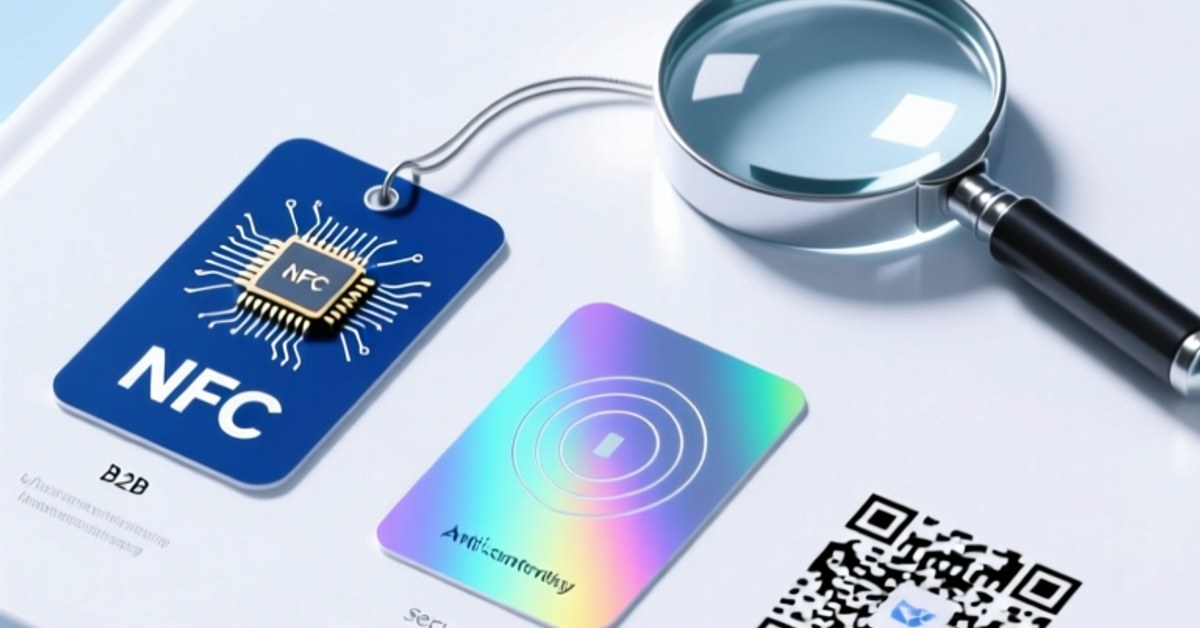
NFC 제품 인증 begins with an NFC 태그, NFC inlay or NFC label embedded in the frame, temple, hinge area or product case. Each tag carries a unique ID that is connected to a secure digital record. When an NFC-enabled smartphone or RFID 리더 comes close, the tag transmits the ID and opens a verification page or 디지털 제품 여권.
A well-implemented system can show the consumer that the frame is genuine, describe the model and material, and confirm that the product was originally manufactured by the brand. The optical retailer can also use the same ID to log sales, activate warranty service or update service history. Because the NFC 태그 does not require a dedicated app on many modern 스마트 폰, a customer can verify a product using only the built-in NFC reader, making luxury eyewear authentication effortless at retail and after the sale.
Placing NFC Tags on Eyewear: Temple and Hinge Design Considerations
Eyewear is a small, curved and electrically complex environment. The temple is usually the most practical location for a tag because it offers enough room for an antenna and remains close to the hand when the user removes the glasses. NFC tags and inlays are available in thin formats designed for embedding into acetate, propionate, nylon, metal and mixed-material frames.
실제로, for temple and hinge tag placement, the best choice depends on the frame structure. A broad acetate temple can hide a standard NFC inlay behind the surface or in a molded cavity. A slim metal temple or spring hinge may require an antenna design tuned for a constrained area. The goal is to preserve the design while keeping the read performance reliable.
Temple and Hinge Placement at a Glance
>
| Placement Option | 최고의 대상 | Suitable Tag Category | 통합 노트 |
|---|---|---|---|
| Inner temple arm | Acetate and plastic frames | Standard NFC tags or NFC inlays | Hidden under acetate or embedded in a molded pocket |
| Temple tip section | Frames with slim arms and wide temple tips | NFC inlay under an overlay | Natural scan point when handling eyewear |
| Hinge zone or metal temple | Metal frames, titanium frames and spring hinges | HF RFID 태그 아니면 반금속 RFID 태그 | Requires prototype testing because metal can detune the antenna |
| Front end-piece or brow bar | Sunglasses with limited temple space | RFID dry inlay or RFID wet inlay | Can be integrated during frame lamination production |
No single placement guarantees performance. The tag antenna can be affected by opaque lens coatings, 수분, metal parts or even the shape of the temple. Design teams should test representative samples with a variety of 스마트 폰 and handheld RFID readers when verifying luxury eyewear authentication in the field.
In-Store Try-On Authentication: Building Trust During the Fitting Experience
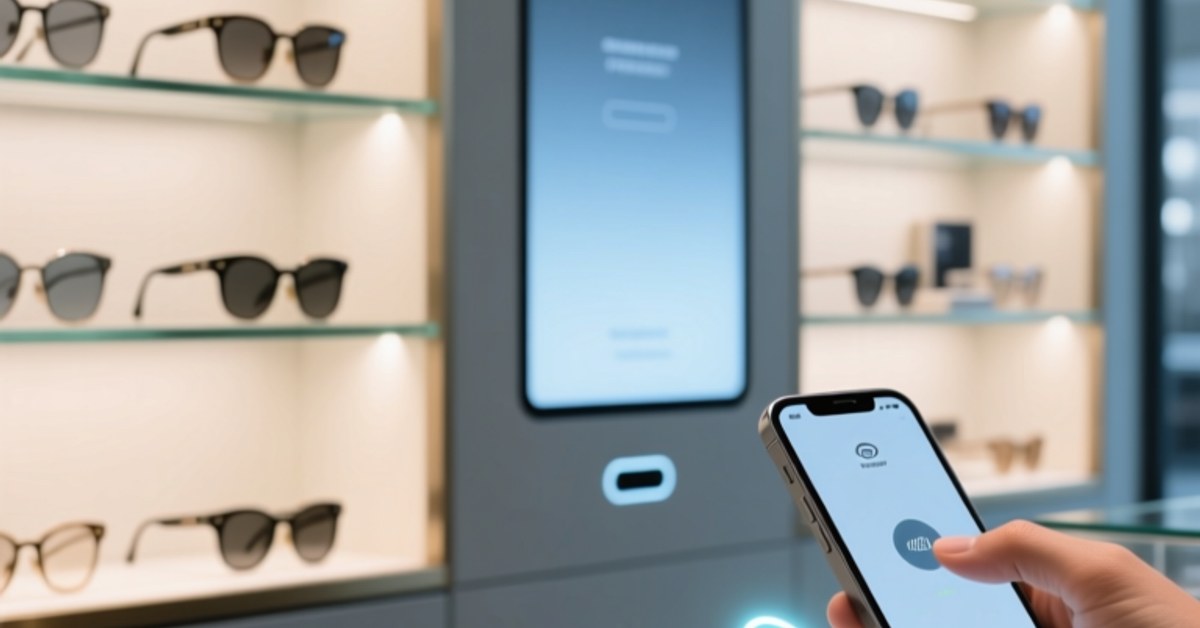
In-store try-on authentication is one of the most useful moments for eyewear brands. When a customer picks up a designer sunglass frame from a display, they can tap the temple with an NFC-enabled smartphone and immediately see the official product record. This makes authentication a natural part of the shopping experience without interfering with the styling advice or optical consultation.
Optical retailers can also use a desktop RFID 리더 or handheld RFID reader at the point of sale to confirm inventory status and product codes. The same scan can help identify display items that have been swapped or returned accidentally. Because the NFC tag is physically linked to the frame, the store can check authenticity before accepting a return and before sending the product for repair or warranty service.
Prescription Frame Traceability: From Optical Lab to Patient
Prescription frame traceability has a unique requirement: the same frame must move from the distributor to the optical laboratory, then to the dispensing optician and finally to the wearer. During this process, prescription lenses are mounted, adjusted, heated and shaped. NFC tags designed for eyewear should survive these handling steps while preserving a readable product identity.
In an optical chain with many branches, the NFC record can store inventory location, frame SKU, bridge size, lens specifications, service visits and warranty eligibility. Instead of manually reading engraved serial numbers, lab staff can use a desktop RFID reader or handheld device to instantly confirm the frame type. That same record can support 디지털 제품 여권 compliance and make replacement ordering easier if the frame requires repair or adjustment.
NFC Authentication for Secondhand Eyewear Resale
The secondhand luxury eyewear market allows consumers to buy pre-owned frames, vintage collections and rare limited editions at more accessible prices. But these channels also contain high counterfeit risk because sellers may not know that an item is fake or may misrepresent it as authentic. The same physical characteristics that make luxury frames desirable also make them easy to imitate in photos.
NFC authentication gives resale platforms a practical screening step. A photo alone cannot confirm the material, serial number and factory origin of a frame, but an NFC scan opens the original product certificate and authenticity history. Buyers can scan a frame after delivery to verify that the product corresponds to the listing. This creates a transparent secondhand eyewear resale experience that benefits both the seller and the buyer.
To protect privacy, tags do not need to expose personal ownership data. The resale check can simply show that the item is a genuine frame from the brand, while ownership transfer functions remain inside a separate secure platform.
Selecting NFC Tags and Inlays for Eyewear Authentication
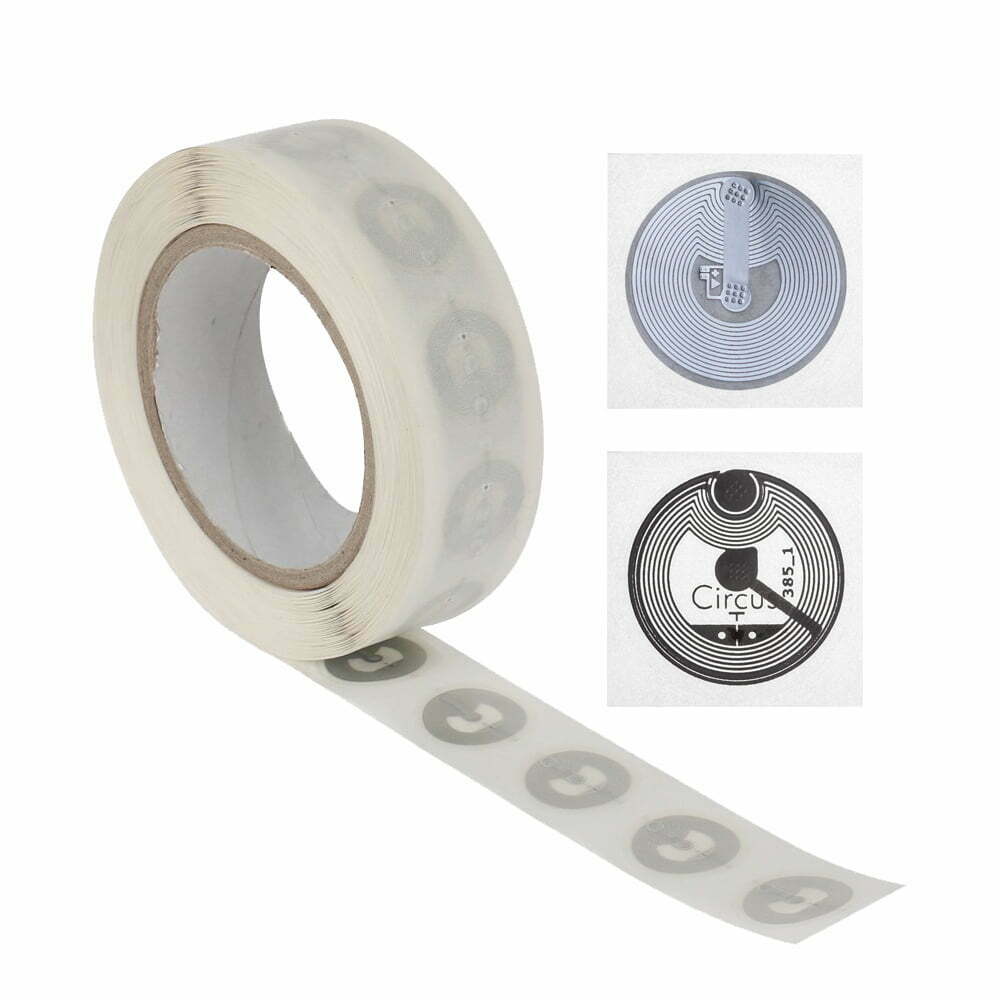
Technology teams should select product categories matched to their manufacturing process. Standard NFC labels and NFC 스티커 can be added to a product case or an instruction card, but the highest level of eyewear brand protection comes from integrating the NFC inlay directly inside the frame or temple.
For flexible production runs, an RFID dry inlay or RFID wet inlay can be supplied for automated placement into acetate or molded components. Optical frames with metal hinges, titanium temples or alloy rim sections require tags that can function near metal. In that scenario, anti-metal RFID tags or HF RFID tags designed for on-metal applications should be tested with actual frame prototypes.
Product categories such as NFC tags, NFC 라벨, NFC 인레이, RFID 건식 인레이, RFID wet inlays and anti-metal RFID tags are available from manufacturers like RFIDHY 그리고 NFCWORK. NFCWORK also provides a range of NFC wearables and labels that can support authentication pilots. No matter which form factor is selected, the tag needs to be paired with a secure product database that the brand controls.
Deploying an NFC Eyewear Authentication Pilot
Before scaling to an entire collection, brands should run a limited pilot on one or two frame models. Start by selecting the placement that matches the frame geometry, then produce 100 에게 200 tagged units for testing in retail locations. Ask store associates to scan frames during daily display checks and ask customers to test the experience on their personal smartphones.
Use the data from the pilot to measure read success rate, page load behavior and customer questions. A successful pilot should confirm that the tag can be read reliably through clear or tinted materials, that the product record is accurate and that the authentication flow works without excessive battery drain or app downloads. Once validated, the same architecture can be extended to new products, prescription inventory and resale verification programs.
NFC technology gives the optics industry a way to connect every physical frame to a digital identity. Whether the goal is to protect a luxury sun collection, manage prescription optical inventory or create a safe resale channel, the result is a stronger connection between the brand and the consumer.
FAQ
Can NFC tags be placed on metal eyeglass frames?
Metal affects radio frequency performance, so a standard NFC tag may not work reliably when placed directly against a metal temple or hinge. A tag designed for on-metal or anti-metal applications should be tested in the actual frame assembly. In many metal luxury frames, the NFC inlay can be positioned inside an acetate insert or in a gap where the RF signal is not fully shielded.
Do consumers need an app to scan NFC-tagged eyewear?
아니요. Most NFC-enabled phones can read a tap and open a web link or show a system notification without requiring a consumer app. Optical retail staff may still use a desktop RFID reader or handheld RFID reader for batch checks, but the end user experience can remain simple and app-free.
How does an NFC tag prove designer glasses authenticity?
The NFC tag alone is a link; security comes from the unique ID and the central product record. The brand must control the verification response and link each tag ID to a genuine frame number. When combined with serialized and protected records, NFC provides reliable optical frame verification for consumers and resellers.
Can a resale buyer verify secondhand luxury sunglasses with NFC?
If the original brand has embedded and registered the NFC tag, the buyer can scan the frame before or after purchase. The system will confirm that the frame corresponds to the manufacturer’s product information. An unreadable, missing or mismatched tag can signal a possible counterfeit or altered product.
What is the best place to put a tag in a sunglass frame?
The inside of the temple is often preferred because it offers enough surface area and is easy for customers to find. For slim or metal temples, the hinge zone or front end-piece can also be tested as an effective placement for NFC authentication.
Bring NFC Authentication to Your Eyewear Collection
NFC authentication can be integrated into luxury sunglasses and optical frames without compromising design, but the right tag type and data strategy depend on your frame materials, manufacturing process and retail channels.
Explore luxury item authentication solutions 또는 NFCWORK에 문의하세요 to discuss how to add frame verification, in-store try-on authentication and resale-ready product records to your eyewear portfolio.