Against the backdrop of increasingly stringent global sustainable development regulations in 2026, Digital Product Passports (DPP) have become a standard requirement for companies entering the European and American markets. However, faced with the two mainstream technologies, RFID and NFC, companies must choose between “supply chain efficiency” and “consumer interaction” when making their selection.
Core Technology Path Comparison: Supply Chain vs. Interaction End
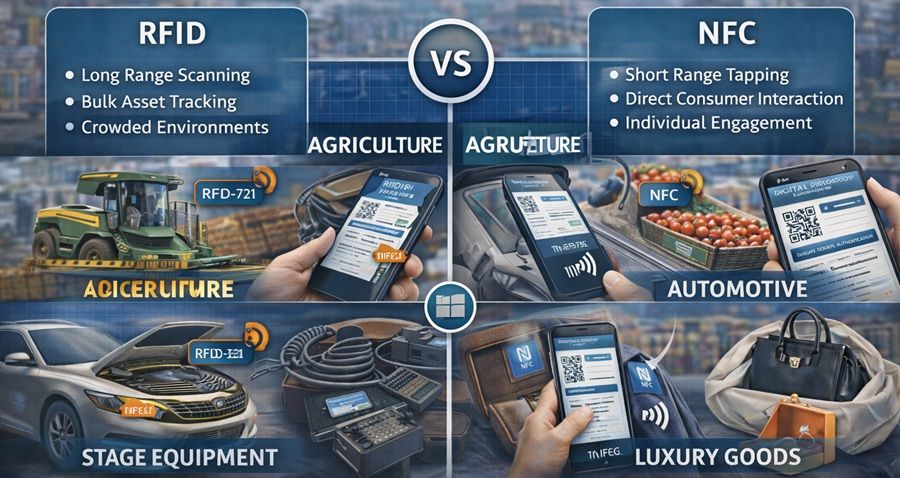
Although NFC is a type of high-frequency RFID (13.56MHz), the underlying logic of the two in DPP applications is completely different.
| Technical Dimension | RFID (UHF) | NFC (HF) |
| Operating Frequency | 860MHz-960MHz | 13.56MHz |
| Reading Distance | Up to 10 meters or more (supports batch reading) | Approximately 10cm (point-to-point sensing) |
| Device Dependence | Requires dedicated portable RFID handheld readers/fixed antennas | Built into smartphones, no additional hardware required |
| Data Security | Relatively high (susceptible to interception, mainly used for tracking) | High (supports NFC tag hardware-level encryption) |
| DPP Role | Supply chain transparency, asset management, inventory counting, rapid identification | Consumer authentication, traceability interaction, circular recycling guidance |
Authoritative Data
According to IDTechEx’s 2025 forecast, more than 55 billion passive RFID tags are consumed globally every year. In the implementation of DPP for luxury goods and high-value products, the adoption rate of NFC is expected to lead the interactive tag market with a compound annual growth rate of 18.2% due to its high security and mobile device compatibility.
DPP Implementation Selection Strategies for Different Industries
1.Textile and Apparel Industry
RFID-dominated efficiency path. For apparel brands with millions of pieces of annual production, the challenge of DPP lies in large-scale inventory counting.
Selection: RFID clothing tags or washable NFC tags.
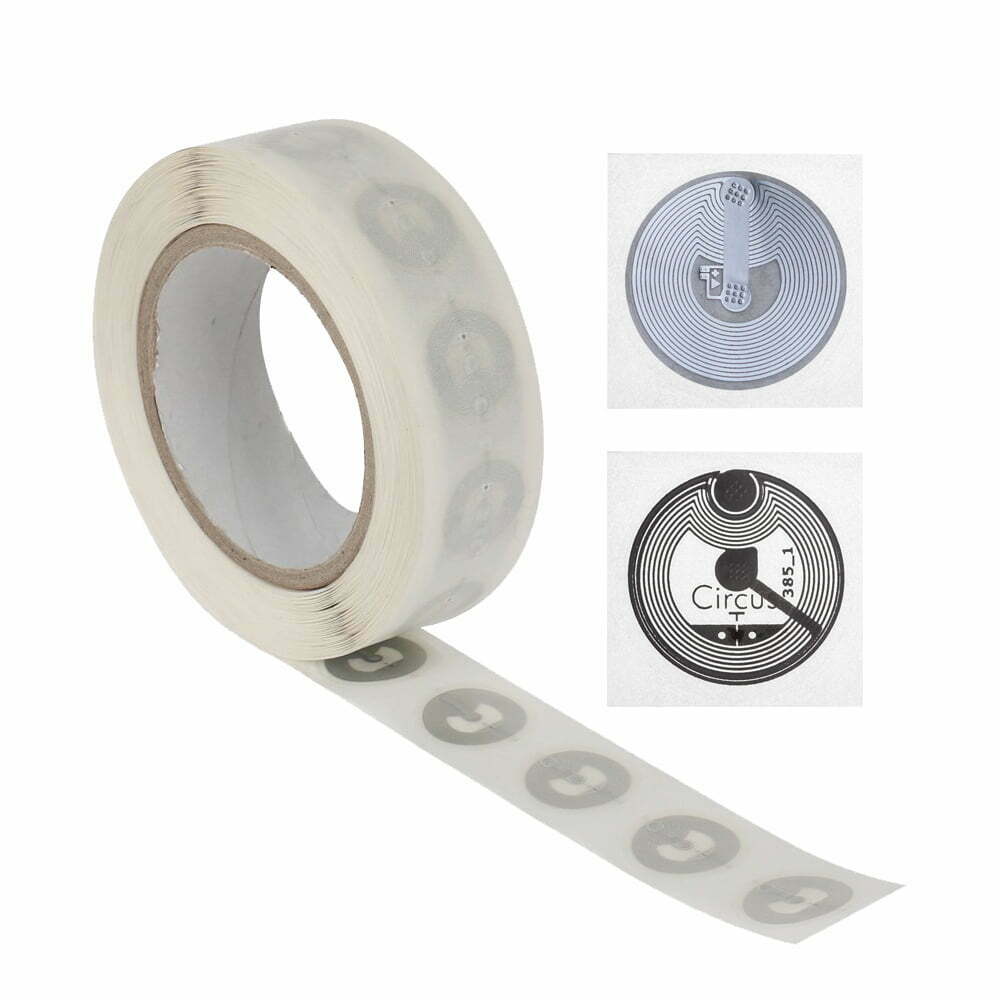
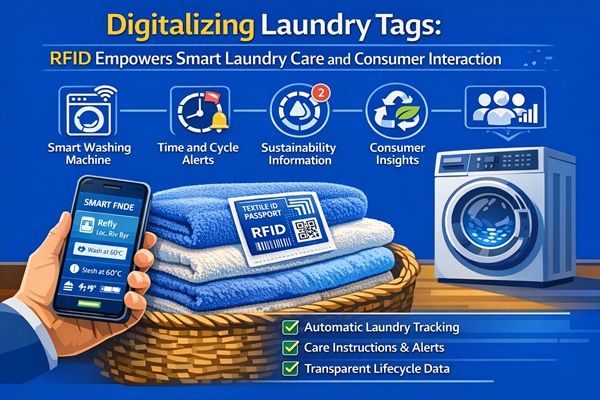
Implementation Path: At the production end, embed RFID laundry tags or flexible wash labels. In the logistics link, use UHF RFID readers to achieve second-level inventory management; at the retail end, use NFC stickers to allow consumers to understand fiber composition and recycling suggestions.
2.Luxury Goods and Electronics
NFC-Driven Security Path Luxury goods emphasize anti-counterfeiting and digital ownership.
Selection: Custom NFC tags with secure chips such as NTAG 424 DNA.
Implementation Path: Invisibly embed a micro NFC chip inside the product. Consumers can simply tap to view the unique electronic identity on the DPP platform, ensuring the tamper-proof nature of the NFC tag. According to Bain & Company research, the resale premium of second-hand luxury goods with this technology can increase by 12%.
3.Industrial Assets and Battery Management
Selection: Industrial RFID tags or on-metal NFC tags.
Implementation Path: For electric vehicle batteries (new EU battery regulations), use anti-metal NFC tags on the metal casing. Maintenance personnel record wear and tear through the RFID asset tracking system, while end-users can read battery health (SoH) data by sensing with their mobile phones.
RFIDHY: Providing Customized DPP Capabilities for All Scenarios
In the implementation of DPP, general standard tags often cannot adapt to extreme environments or high-end design requirements. With over 20 years of industry experience, RFIDHY provides industry-leading customization capabilities:
- Material Customization: Providing ultra-thin NFC chip stickers, embedded micro RFID tags, and custom tags that withstand high temperatures and strong acids and alkalis.
- Appearance Customization: Supports custom printed NFC stickers and printed NFC cards, ensuring brand visual consistency.
- Technology Adaptation: For different physical surfaces (such as leather, metal, composite materials), precisely match on-metal RFID tag technology to ensure a 100% reading rate.
Expert Recommended Products
- Encrypted NFC Tags: Suitable for luxury goods anti-counterfeiting, supporting AES encryption.
- Industrial-grade anti-metal tags: UHF RFID anti-metal tags designed for battery and heavy equipment tracking.
- NTAG215 NFC Smart Card: Custom NFC cards designed for high-interaction scenarios.
- HF/UHF Dual-Frequency Tags: Meeting the dual needs of RFID and NFC functions. Contact technical personnel for specific details.
For more information,please contact us.