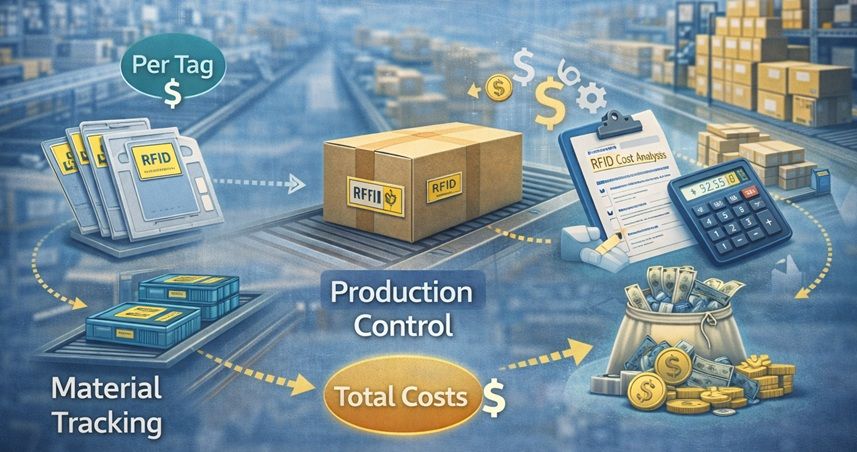
Introduction: Le coût réel d'un projet RFID va bien au-delà du prix unitaire de l'étiquette
Selon GS1 2025 Rapport de référence sur le retour sur investissement RFID, dans les projets typiques de traçabilité d’un seul article, le coût d'achat de Étiquettes RFID ne représente que 28-35% du coût total de possession (Coût total de possession). Le reste 65-72% vient du matériel du lecteur, licence de logiciel, intégration du système, entraînement, et entretien à long terme. Cet article, basé sur les données d'analyse du TCO de 100 Projets RFID dans le secteur européen du commerce de détail, révèle la composition complète des coûts de mise en œuvre, aider les entreprises à prendre des décisions d'investissement éclairées.
Cinq éléments clés du coût total de possession de la RFID (Coût total de possession)
1.1 Coût de l'étiquette: En baisse continue mais nécessitant toujours un calcul minutieux
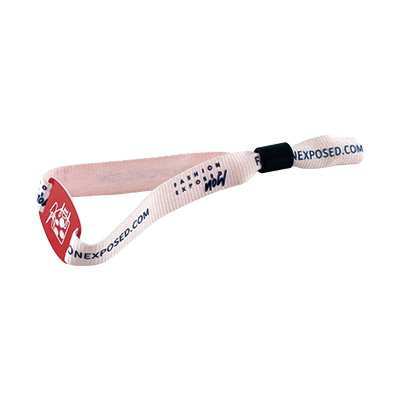
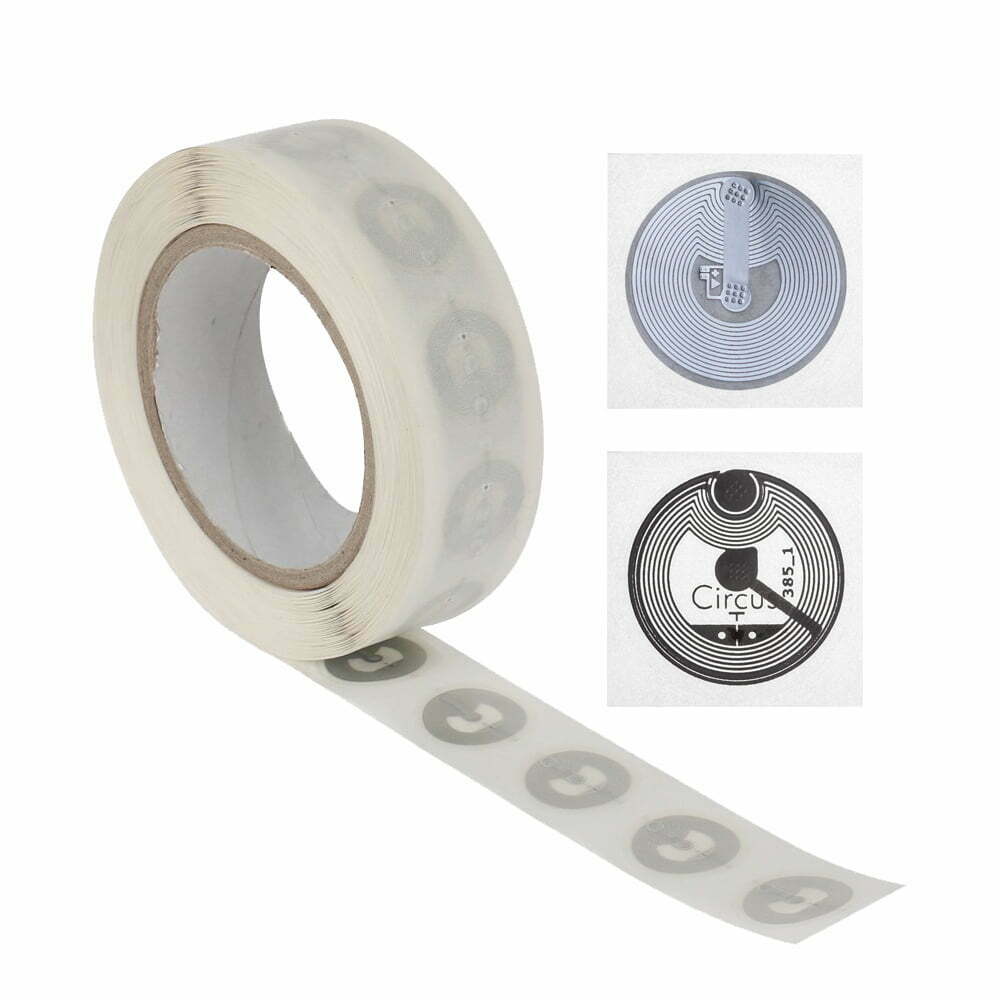
Actuellement, le prix unitaire de Étiquettes RFID UHF est tombé à 0,1-0,22 € par étiquette (basé sur NXP UCODE 8 ou puces Impinj M730). Étiquettes lavables, en raison de leur processus d'emballage complexe, coût entre 0,25 et 0,45 € par étiquette. Basé sur une utilisation annuelle de 5 millions de tags, la dépense annuelle en étiquettes est d'environ 250 000 à 400 000 €.
1.2 Équipement matériel: Investissement initial dans des lecteurs et des antennes
- Terminaux portables: Tel que RFIDHY HY-R6100, prix unitaire environ 590-650€, durée de vie 3-5 années
- Lecteurs fixes: RFIDHY HY-R346A environ 485 €/unité, Nordic ID RR900 environ 3 200 €/unité
- Unités de tunneling: RFIDHY Tunnel, investissement 30 000-80 000 €/set selon configuration
- Antennes: RFIDHY HY-RA9002 9dbi (65-75€), Fois-7 A5020 (320-450 €)
1.3 Logiciel et intégration: Le souvent sous-estimé “Coût caché”
- Licences d'intergiciel RFID: Tarif par lecteur ou annuellement, Impinj ItemSense coûte environ 2 000 à 5 000 € par an.
- Développement d'intégration ERP: En fonction de la complexité du système, L'intégration SAP/Oracle coûte généralement entre 20 000 et 50 000 €.
- Développement personnalisé: Des règles commerciales spéciales et des exigences de reporting ajoutent entre 10 000 et 30 000 €.
1.4 Mise en œuvre et service
- Enquête sur site et installation: 300 à 800 € par lecteur/écrivain
- Main d’œuvre pour l’application des étiquettes: Si l’étiquetage est fait à la source du fournisseur, le coût est négligeable; si l'étiquetage de l'entrepôt est effectué, environ 0,02 à 0,05 € par article.
- Opération de formation et d’essai: 5 000 à 15 000 € par projet.
1.5 Coûts d’exploitation et de maintenance à long terme
- Frais de maintenance annuels: 8-12% de la valeur matérielle
- Taux de dommages aux étiquettes: Expérience d'étiquettes lavables environ 2-5% dégâts annuels; les étiquettes volantes sont négligeables.
- Mises à niveau et assistance du système: Les frais annuels du logiciel incluent généralement le support de base.
Analyse du coût total de possession: Une étude de cas d'une marque avec 5 Millions de pièces utilisées chaque année
En supposant une marque de vêtements de taille moyenne (Par exemple, StreetWear allemand) GmbH a mis en œuvre un projet RFID avec une utilisation annuelle de 5 millions de tags (95% étiquettes volantes + 5% lavable), déploiement 20 terminaux portables, 4 unités de tunnel, et 2 lecteurs fixes, intégré à SAP ERP. L’analyse du TCO est la suivante:
| Article de coût | Coût de la première année | Coût annuel moyen (Années 2-5) | Pourcentage |
| Approvisionnement en étiquettes | 275 000 € | 275 000 € | 31% |
| Équipement matériel | 198 000 € | 18 000 € (Dépréciation) | 22% |
| Logiciel et intégration | 68 000 € | 15 000 € | 10% |
| Mise en œuvre et service | 42 000 € | 8 000 € | 7% |
| Entretien et réduction des dommages | 15 000 € | 25 000 € | 7% |
| Coût total de possession annuel | 598 000 € | 341 000 € | 100% |
Aperçu clé: Le coût de mise en œuvre de la première année est relativement élevé, mais le TCO diminue de 43% dans les années suivantes. Avec un chiffre d'affaires annuel de 120 millions d'euros, Le TCO RFID représente environ 0.28-0.5% de revenus, tandis que les avantages tels que l'optimisation des stocks, efficacité améliorée du comptage des stocks, et les pertes réduites couvrent généralement 2-3 fois le coût.
Comment la personnalisation optimise le TCO
RFIDHY, avec ses capacités de personnalisation approfondies, aide les clients à optimiser le TCO dans les domaines suivants:
* Optimisation de la sélection des balises: Recommander les puces les plus rentables en fonction de scénarios d'application (Par exemple, NXPUCODE 9 contre Impinj M730), éviter la surperformance des performances.
* Configuration matérielle précise: Éviter les antennes excessives ou le gaspillage d’énergie grâce à la simulation sur site.
* Contrôle des coûts d'intégration: Fournir des API RESTful standard et des connecteurs SAP/Oracle prédéfinis, réduire les coûts de développement de l'intégration en 40%.
* Maintenance prédictive: Un middleware surveille l’état des équipements en temps réel, réduire les pertes imprévues dues aux temps d'arrêt.
Conclusion
Par 2026, le coût de mise en œuvre des projets RFID sera hautement transparent, le prix unitaire de l'étiquette ne représentant qu'une petite fraction. Une analyse scientifique du TCO doit couvrir l’ensemble du cycle de vie du matériel, logiciel, intégration, et l'exploitation et l'entretien. Choisir un partenaire possédant une expérience du secteur et des capacités de personnalisation (comme RFIDHY) peut réduire le coût total de possession global de 15-25% sans affecter les performances.
FAQ
T1: Les coûts des étiquettes peuvent-ils continuer à diminuer?
Selon VDC Research, Les prix des étiquettes RFID UHF devraient diminuer de 2-3% chaque année à partir de 2026 à 2028, principalement en raison de l'intégration accrue des puces et des économies d'échelle. Cependant, les étiquettes lavables ont une marge limitée de réduction de prix en raison de processus d'emballage complexes.
T2: Comment estimer le TCO RFID de votre entreprise?
Nous recommandons une approche en quatre étapes: 1) Déterminer le volume d'utilisation annuel et le type de balise; 2) Analyser le nombre de points de lecture/écriture et les besoins en équipement; 3) Évaluer la complexité d’intégration des systèmes ERP/WMS existants; 4) Consulter des fournisseurs expérimentés (comme RFIDHY) pour les devis préliminaires et les modèles TCO.
T3: Comment les PME peuvent-elles contrôler les coûts de mise en œuvre?
Une approche de mise en œuvre progressive est recommandée: commencez avec des articles individuels de grande valeur, utiliser des terminaux portables au lieu de terminaux tunnel, et choisissez le middleware SaaS au lieu du déploiement sur site. RFIDHY propose un kit de démarrage léger (y compris 2 terminaux portables + 5000 balises + licence de logiciel), nécessitant un investissement initial de 15 000 € pour démarrer.
T4: Quelle est la durée d'amortissement typique du matériel ??
Les terminaux portables et les lecteurs fixes sont généralement amortis sur 3-5 années, tandis que les équipements automatisés tels que les tunneliers sont amortis sur 5-7 années. Les produits de marques comme Impinj peuvent avoir une durée de vie allant jusqu'à 1.5 multiplié par leur durée d'amortissement dans des conditions normales d'utilisation.
Pour plus d'informations,s'il te plaît Contactez-nous.